
StarkWare Launches Quantum-Safe Bitcoin Prototype to Combat Future Threats
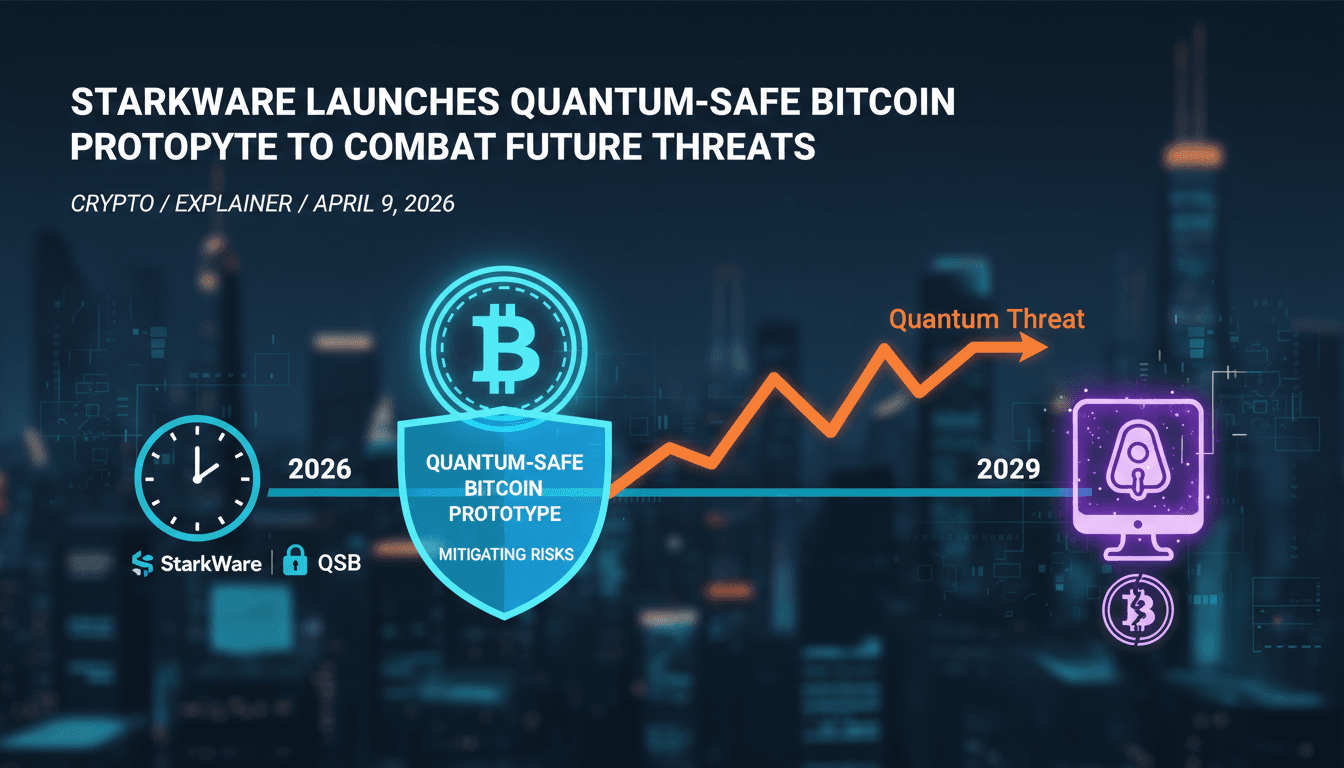
Here's what it means for you.
As quantum computing advances, securing your Bitcoin investments against potential threats is becoming increasingly crucial.
Why it matters
This development could redefine the security landscape for Bitcoin, impacting how individuals and institutions manage their crypto assets.
What happened (in 30 seconds)
- On April 9, 2026, StarkWare's Avihu Levy released the Quantum Safe Bitcoin (QSB) prototype on GitHub.
- The QSB scheme allows Bitcoin transactions to resist quantum attacks without requiring protocol changes.
- Community reactions have been mixed, with some endorsing the prototype while others raise concerns about its scalability and costs.
The context you actually need
- Bitcoin's ECDSA signatures are vulnerable to quantum attacks, which could lead to theft from exposed public keys.
- Google's March 2026 research indicated that breaking ECDSA could require approximately 500,000 logical qubits by 2029, heightening urgency for solutions.
- 1.7 million BTC are held in legacy P2PK addresses, which are particularly at risk from quantum threats.
What's really happening
The release of the Quantum Safe Bitcoin (QSB) prototype marks a significant step in addressing the looming threat of quantum computing to Bitcoin's security framework. The prototype, developed by StarkWare, utilizes a hash-to-signature puzzle that allows senders to solve a computational challenge that mimics a valid ECDSA signature. This method operates within the existing Bitcoin script limits, meaning it does not necessitate any protocol changes or soft forks, which have historically been contentious within the Bitcoin community.
StarkWare's CEO, Eli Ben-Sasson, publicly endorsed the QSB, asserting that Bitcoin can now be considered quantum-safe without requiring any modifications to its underlying protocol. This assertion comes at a critical time, as recent research from Google has revealed that the qubit requirements for effectively breaking Bitcoin's ECDSA signatures are decreasing, with estimates suggesting that viable attacks could be possible by 2029. This timeline has intensified discussions within the community regarding potential upgrades, such as BIP-360, aimed at enhancing Bitcoin's resilience against quantum threats.
Despite the excitement surrounding the QSB, the Bitcoin community's response has been mixed. While some see it as a viable interim solution, others, including notable figures like Daniel Batten, have raised concerns regarding the high computational costs associated with executing QSB transactions—estimated between $75 and $150 in GPU compute. Furthermore, critics point out that the QSB does not protect legacy exposed addresses, which could leave a significant portion of Bitcoin holdings vulnerable. With approximately 1.7 million BTC in early P2PK addresses at risk, the urgency for a more comprehensive solution remains.
As the QSB prototype undergoes community debate and scrutiny, its implications extend beyond just technical specifications. The development underscores a growing recognition of the need for proactive measures in the face of emerging quantum threats. For high-net-worth individuals and institutions, especially in crypto-friendly regions like Dubai, the QSB presents an opportunity to secure large Bitcoin holdings without the immediate pressure of protocol upgrades. This could lead to increased adoption of quantum-safe practices among investors looking to safeguard their assets against future vulnerabilities.
Who feels it first (and how)
- Crypto Investors: Individuals holding Bitcoin in legacy addresses are at immediate risk and may need to consider transitioning to quantum-safe solutions.
- High-Net-Worth Individuals: Those in crypto-friendly regions, such as Dubai, may explore QSB to protect significant investments.
- Institutional Investors: Firms managing large crypto portfolios will need to assess the implications of quantum threats on their strategies.
What to watch next
- Community Consensus: Monitor discussions around the QSB prototype and potential upgrades like BIP-360, as these will shape the future of Bitcoin's security.
- Quantum Computing Advancements: Keep an eye on developments in quantum computing capabilities, particularly any breakthroughs that could affect ECDSA vulnerabilities.
- Adoption Rates: Watch how quickly institutions and high-net-worth individuals adopt quantum-safe practices, as this could signal broader market trends.
The QSB prototype is operational and available for community testing.
Continued debate within the Bitcoin community regarding the effectiveness and scalability of the QSB will shape future developments.
The long-term impact of quantum computing on Bitcoin's market value and security practices remains uncertain.
Insights by A47 Intelligence
News and analysis on Bitcoin, altcoins, and blockchain innovation.
"Bitcoinist delivers news and analysis on Bitcoin, altcoins, and blockchain innovation with a focus on market trends and industry updates."
— A47 Editor
Bitcoin May Avoid Immediate Quantum Upgrade With New Workaround: Study
A new proposal by StarkWare's Chief Product Officer, Avihu Levy, suggests a method called Quantum Safe Bitcoin (QSB) that could enhance Bitcoin's resistance to quantum computing threats without necessitating a soft fork. This approach allows for Bitc...
Covers blockchain, cryptocurrency news, project analysis, and market insights.
"CoinDesk is a well-established cryptocurrency and blockchain news provider, offering comprehensive insights, market data, and industry research."
— A47 Editor
Quantum-safe bitcoin now possible without a soft fork, but costs $200 a pop, new research shows
New research from a StarkWare researcher indicates that quantum-safe bitcoin can now be achieved without requiring a soft fork, with each implementation costing approximately $200. This development provides an emergency fallback while the Bitcoin Imp...
Covers Bitcoin plus altcoin news, market updates, and educational resources.
"Bitcoin.com provides news, market data, and guides focused on Bitcoin and the wider crypto industry."
— A47 Editor
No Consensus Changes Needed: Starkware CPO Builds Quantum-Safe Bitcoin Transactions From Existing Rules
Starkware's Chief Product Officer, Avihu Levy, announced the development of quantum-safe Bitcoin transactions that can be implemented without requiring changes to the existing consensus rules. This innovation aims to enhance the security of Bitcoin a...