
Iraqi Parliament Elects Nizar Amedi as President Amid Political Deadlock
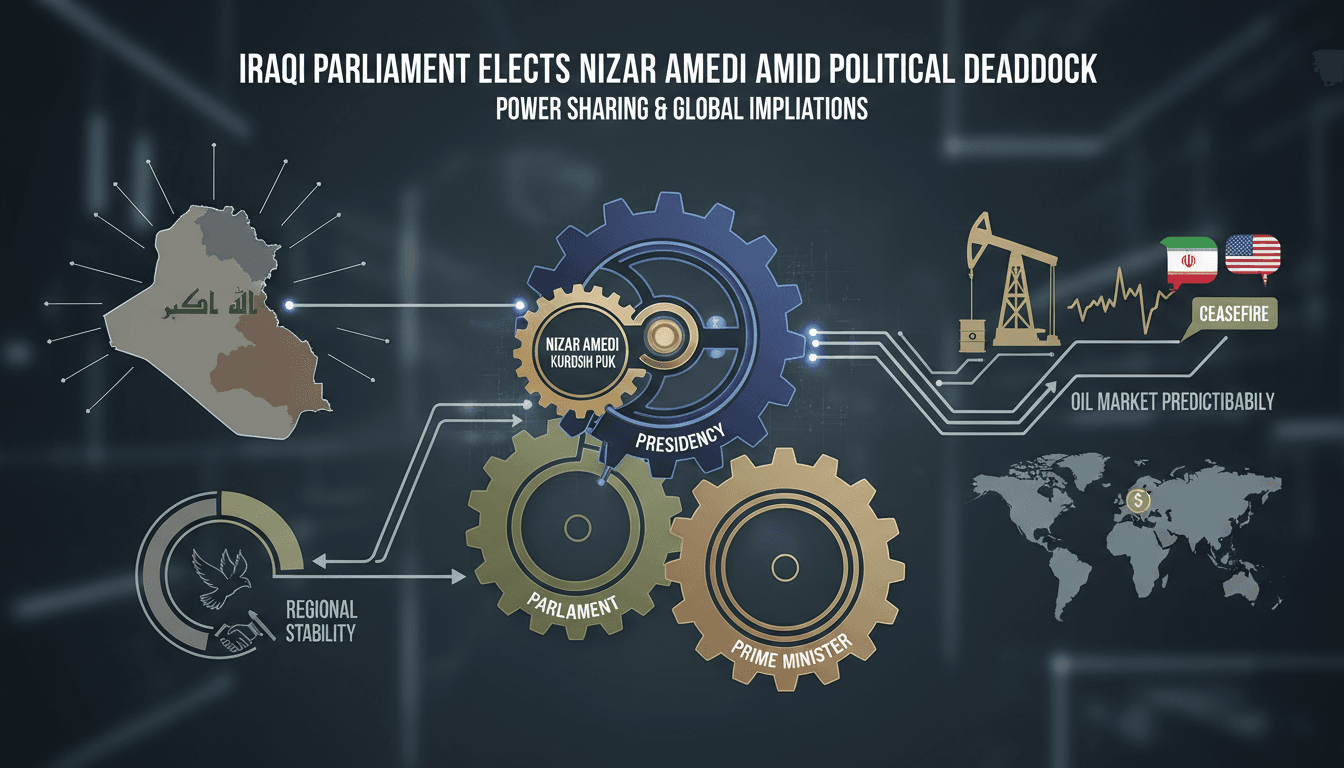
Here's what it means for you.
The election of Nizar Amedi as Iraq's president could influence regional energy markets, indirectly impacting your energy costs.
Why it matters
This election is a crucial step toward forming a stable government in Iraq, which can affect oil supply and prices globally.
What happened (in 30 seconds)
- Nizar Amedi was elected president by the Iraqi Parliament on April 11, 2026, amid a political deadlock.
- Amedi, a member of the Patriotic Union of Kurdistan (PUK), received 227 votes in the second round, securing 90.08% of the votes cast.
- The KDP boycotted the election session, citing procedural flaws, while Prime Minister Mohammed Shia al-Sudani praised the election as a significant step forward.
The context you actually need
- Iraq's power-sharing system mandates that the presidency be held by a Kurd, the prime minister by a Shiite, and the parliamentary speakership by a Sunni, reflecting the country's sectarian divisions.
- Political deadlock followed the inconclusive November 2025 elections, with rival parties struggling to agree on a presidential candidate, delaying governance.
- Recent geopolitical tensions, including a six-week US-Iran conflict, have heightened the stakes for Iraq's political stability and its oil market.
What's really happening
The election of Nizar Amedi as president marks a significant moment in Iraq's complex political landscape, shaped by a power-sharing arrangement designed to maintain balance among the country's diverse ethnic and sectarian groups. Amedi's election follows a protracted period of political deadlock that began after the November 2025 parliamentary elections, where no party secured a clear majority. This deadlock was exacerbated by intense rivalry between the two main Kurdish parties: the Patriotic Union of Kurdistan (PUK), which nominated Amedi, and the Kurdistan Democratic Party (KDP), which backed Fuad Hussein.
The parliamentary session on April 11, 2026, was notable for achieving quorum despite boycotts from the KDP and some Shiite and Sunni factions. In the first round of voting, Amedi received 208 votes, a clear indication of support from the majority of parliamentarians present. The second round solidified his position, with 227 votes in favor, surpassing the constitutional threshold required for election. This decisive victory is not just a win for Amedi but also a reflection of the PUK's strategic maneuvering within Iraq's political framework.
The backdrop of this election is critical. The recent ceasefire following a six-week conflict between the US and Iran has created a precarious environment in which Iraq must navigate its internal politics while also addressing external pressures. The outcome of this election could facilitate a more stable government, which is essential for Iraq's economic recovery and its role in the global oil market. A stable Iraq can help ensure predictable oil exports, which is particularly relevant for energy-dependent economies like the UAE.
Moreover, the election's implications extend beyond Iraq's borders. Amedi's presidency could signal a shift towards greater cooperation among Iraq's political factions, potentially leading to a more unified approach to governance and economic policy. This, in turn, could stabilize the region and contribute to a more predictable oil supply, which is crucial for global markets. As Iraq continues to grapple with its sectarian divisions, the success of Amedi's presidency will depend on his ability to foster collaboration among the various political factions and address the pressing issues facing the country.
Who feels it first (and how)
- Energy Sector Professionals: Changes in Iraq's political stability can directly impact oil supply and prices, affecting energy markets globally.
- Investors in Middle Eastern Markets: Political stability in Iraq may attract foreign investment and influence market dynamics in the region.
- UAE Residents and Businesses: As a major importer of Iraqi oil, any shifts in Iraq's governance could affect energy costs and market predictability in the UAE.
What to watch next
- Prime Minister Selection: The nomination of Nouri al-Maliki by the pro-Iran Coordination Framework could influence Iraq's political direction and its relations with the US.
- KDP Response: How the KDP reacts to Amedi's presidency and whether they will engage in future parliamentary sessions will be crucial for political stability.
- Oil Market Reactions: Monitor oil prices and supply levels in the wake of Amedi's election, as they may reflect changes in market confidence regarding Iraq's governance.
Nizar Amedi has been elected president of Iraq.
Amedi's presidency will facilitate the selection of a new prime minister, impacting Iraq's governance.
The long-term effects of this election on Iraq's political stability and its oil market dynamics remain to be seen.
Insights by A47 Intelligence
Comprehensive coverage of Middle Eastern and global issues.
"Al Jazeera is a prominent voice from the Global South, especially the Middle East, with an emphasis on underreported stories."
— A47 Editor
Iraq parliament elects Kurdish politician Nizar Amedi as president
The Iraqi parliament has elected Kurdish politician Nizar Amedi as the new president, securing 227 votes and effectively ending a five-month political deadlock in the country. Amedi's election marks a significant step in Iraq's political landscape, a...
Regional and international reporting focused on Middle Eastern politics, diplomacy, and economics.
"Asharq Al-Awsat is a Saudi-owned international newspaper reflecting mainstream Gulf political perspectives."
— A47 Editor
Iraqi Parliament Elects Nizar Amedi as Country’s New President
The Iraqi Parliament has elected Nizar Amedi as the new President of Iraq, marking a significant political development in the country. This election reflects the ongoing efforts within the Iraqi political landscape to establish leadership and governa...
Conservative-leaning political and national coverage.
"The Washington Times is a conservative-leaning newspaper known for its political coverage and advocacy of right-of-center viewpoints."
— A47 Editor
Iraq elects Kurdish politician Nizar Amidi as president amid war fallout
Iraq's parliament voted to elect Nizar Amidi, a politician affiliated with one of the country's two main Kurdish parties, as president on Saturday, following a parliamentary election five months prior that failed to yield a decisive majority bloc. Th...