
Meta Superintelligence Labs Launches Muse Spark AI Model
Here's what it means for you.
As businesses increasingly adopt AI tools, understanding Muse Spark's capabilities could enhance your strategic decision-making.
Why it matters
Meta's new AI model positions the company as a formidable competitor in the rapidly evolving landscape of artificial intelligence.
What happened (in 30 seconds)
- Meta Superintelligence Labs launched Muse Spark on April 8, 2026, marking its first proprietary AI model.
- The model excels in multimodal reasoning, processing voice, text, and images, and is integrated into the Meta AI app.
- Meta's stock rose by 6.5% following the announcement, reflecting market optimism about its AI advancements.
The context you actually need
- Meta Superintelligence Labs was formed in June 2025 to enhance Meta's AI capabilities amid fierce competition from OpenAI and Google.
- The $14.3 billion acquisition of Scale AI allowed Meta to recruit top talent and rebuild its AI infrastructure, addressing previous limitations.
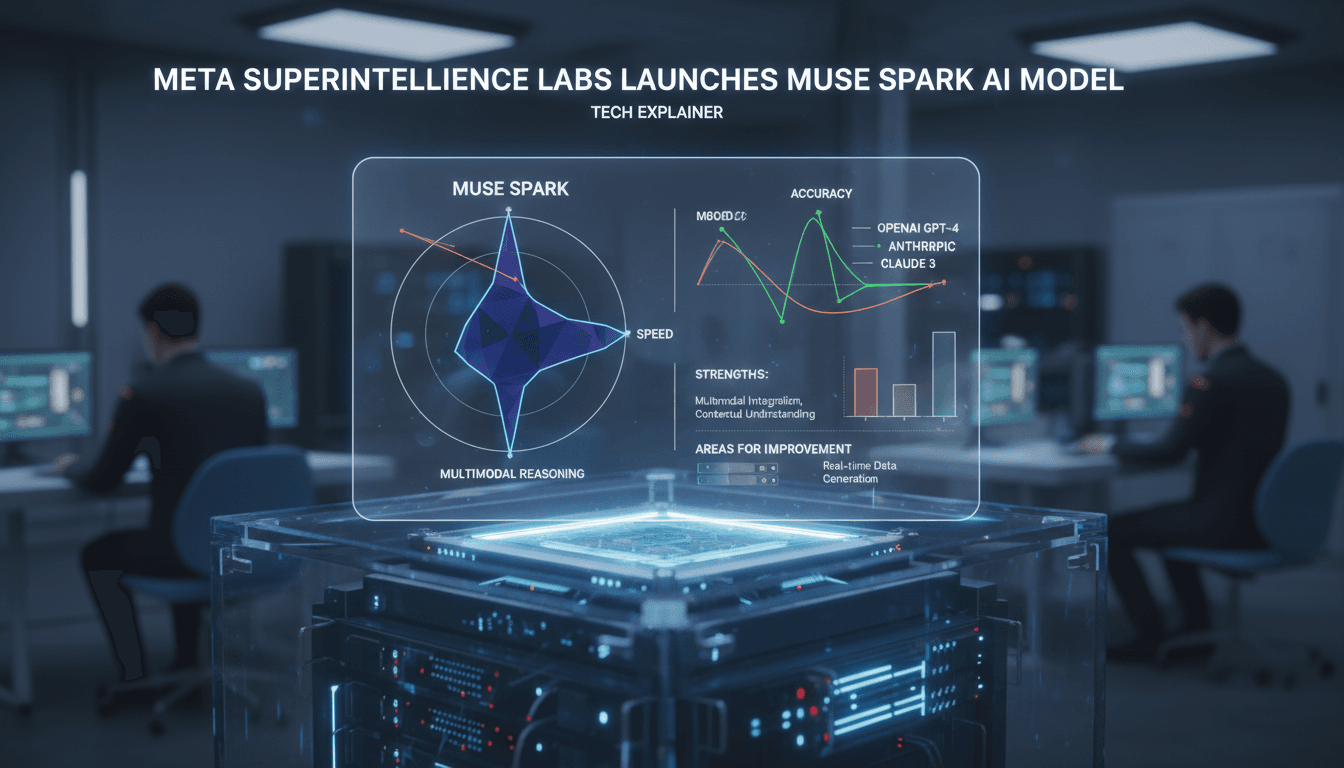
- Muse Spark's performance is notable, scoring 52 on the Artificial Analysis Intelligence Index, ranking fourth among leading AI models.
What's really happening
Meta's launch of Muse Spark is a strategic pivot from its earlier open-source Llama models to a proprietary framework aimed at personal superintelligence. This shift is significant for several reasons. First, the establishment of Meta Superintelligence Labs in June 2025 under Mark Zuckerberg's leadership was a direct response to the competitive pressures from other AI giants like OpenAI, Google, and Anthropic. The $14.3 billion acquisition of Scale AI not only provided Meta with advanced technology but also facilitated a complete overhaul of its AI talent pool and infrastructure. Alexandr Wang, the former CEO of Scale AI, was brought in to lead this transformation, focusing on multimodal reasoning capabilities that can process various forms of input—text, voice, and images—simultaneously.
The Muse Spark model, launched on April 8, 2026, integrates these advancements into the Meta AI app, making it accessible to a global audience. Its features include visual grounding, parallel agent orchestration, and a contemplating mode, which enhance its reasoning capabilities. This positions Muse Spark as a strong contender against existing models from OpenAI and Google, which have dominated the market.
The immediate market reaction was positive, with Meta's stock increasing by 6.5% on the announcement day, signaling investor confidence in the company's AI direction. Analysts praised Muse Spark's benchmarks, although some noted that it still lags in certain coding tasks compared to its competitors. This indicates that while Meta is making strides, it still has challenges to overcome to fully compete on all fronts.
The transition from open-source to proprietary models signifies a broader trend in the AI industry, where companies are increasingly focusing on developing unique, in-house technologies to maintain competitive advantages. This move could reshape how AI tools are accessed and utilized across various sectors, potentially leading to a more fragmented market where proprietary models dominate.
Who feels it first (and how)
- Tech companies: They will need to adapt to new AI capabilities and possibly integrate Muse Spark into their operations.
- Developers and engineers: Those working in AI will face new challenges and opportunities as they learn to work with proprietary models.
- Businesses across sectors: Companies looking to leverage AI for efficiency and innovation will need to evaluate how Muse Spark can fit into their strategies.
- Investors: They will monitor Meta's performance and market positioning closely, as AI advancements could significantly impact stock valuations.
What to watch next
- Adoption rates of Muse Spark: Tracking how quickly businesses integrate this model will indicate its market impact.
- Performance benchmarks against competitors: Observing how Muse Spark stacks up against models from OpenAI and Google will reveal its strengths and weaknesses.
- Future open-sourcing decisions: Meta's potential shift back to open-sourcing could influence the competitive landscape and accessibility of AI technologies.
Muse Spark is publicly available via the Meta AI app and has received positive initial market reactions.
Businesses will begin integrating Muse Spark into their operations, influencing productivity and innovation.
The long-term impact of Muse Spark on Meta's market position and the AI landscape remains to be seen.
Insights by A47 Intelligence
Daily curated AI news and tools.
"High-signal newsletter summarizing model and product news."
— A47 Editor
Meta Superintelligence Labs ships its first model
Meta's Superintelligence Labs has officially launched its first AI model, Muse Spark, marking a significant milestone in the company's ongoing efforts to enhance artificial intelligence capabilities. This model aims to improve reasoning abilities wit...
Technology and innovation coverage, including consumer tech and digital transformation stories.
"Emirates 24|7 technology coverage often highlights practical tech developments with relevance to Gulf readers and businesses."
— A47 Editor
Meta unveils first AI model from superintelligence team Meta unveils first AI model from superintelligence team
Meta Platforms has introduced Muse Spark, its first artificial intelligence model developed by a newly formed superintelligence team, aimed at enhancing its competitive edge in the AI sector. This model, part of a series called Avocado, will initiall...
Focuses on transformative tech, AI, gaming, and startup innovation.
"VentureBeat is respected for its in-depth reporting on AI, startups, and disruptive technologies in Silicon Valley and beyond."
— A47 Editor
Goodbye, Llama? Meta launches new proprietary AI model Muse Spark — first since Superintelligence Labs' formation
Meta has launched its new AI model, Muse Spark, marking the first release from its recently established Superintelligence Labs. This model aims to enhance reasoning capabilities within the Meta AI app and follows a challenging period for the company ...