
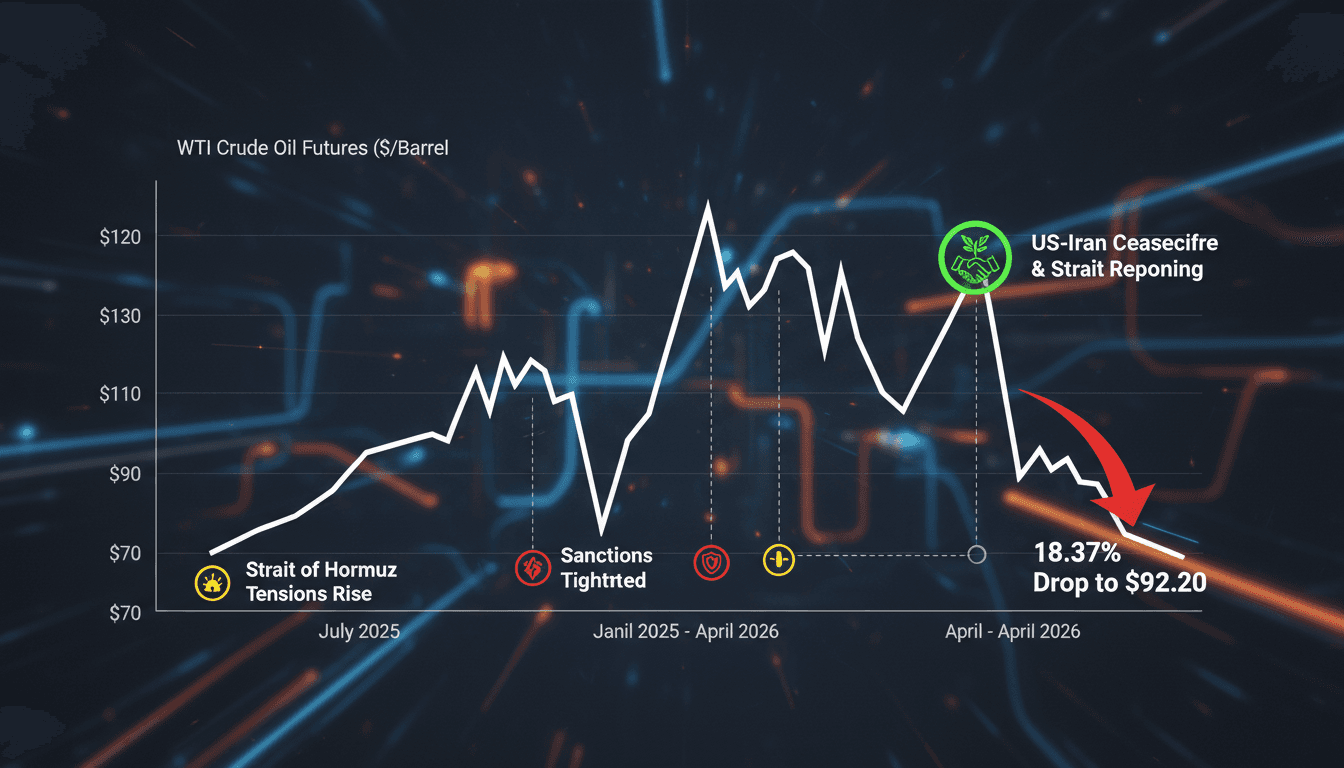
WTI Crude Oil Futures Drop 18% Following US-Iran Ceasefire and Strait of Hormuz Reopening
Here's what it means for you.
The recent drop in oil prices could lead to lower transportation costs and energy prices, impacting your daily expenses.
Why it matters
This significant decline in oil prices reflects geopolitical stability, which can influence global markets and consumer costs.
What happened (in 30 seconds)
- WTI crude oil futures fell 18.37% to $92.20 per barrel following a ceasefire announcement between the US and Iran.
- Brent crude futures dropped 16.68% to $90.93 per barrel, alleviating fears of supply disruptions.
- Global equities surged, with major indices like the Dow Jones and S&P 500 seeing gains of up to 2.7%.
The context you actually need
- Escalating tensions between the US and Iran had previously driven oil prices above $110 per barrel due to fears of supply shortages.
- The Strait of Hormuz, a crucial passage for oil shipments, reopened as part of the ceasefire, easing market concerns.
- US crude inventories showed a modest drawdown, indicating that supply levels may stabilize in the near term.
What's really happening
On April 8, 2026, the announcement of a two-week ceasefire between the United States and Iran marked a pivotal moment in the global oil market. The ceasefire, which includes the reopening of the Strait of Hormuz, a vital chokepoint for 20% of the world's oil supply, led to an immediate and dramatic reaction in oil futures trading. WTI crude oil futures on the New York Mercantile Exchange (NYMEX) plummeted by 18.37%, while Brent crude futures on ICE Futures Europe fell by 16.68%.
This price drop is rooted in the alleviation of fears surrounding supply disruptions that had been exacerbated by escalating tensions earlier in the year. US President Donald Trump's ultimatums had heightened concerns about potential military actions, which could have severely impacted oil shipments through the Strait of Hormuz. With prices soaring above $110 per barrel, the market was ripe for a correction once the ceasefire was announced.
The immediate aftermath saw a surge in global equities, reflecting investor optimism about reduced energy costs and a stabilization of markets. The Dow Jones Industrial Average rose by approximately 2.5-2.7%, while the S&P 500 gained about 2.3%. This bullish sentiment is indicative of how closely tied global markets are to oil prices, as fluctuations in energy costs can have ripple effects across various sectors.
However, while the ceasefire has provided a temporary reprieve, analysts caution that the situation remains fragile. The potential for renewed tensions could lead to further volatility in oil prices. As of April 9, 2026, prices were stabilizing in the $93-97 range, but the market is on alert for any signs of escalation.
The broader implications of this price drop extend beyond immediate market reactions. Lower oil prices can lead to reduced transportation costs, which may benefit consumers directly through lower fuel prices. However, for oil-exporting nations, particularly those in the Gulf region like the UAE, lower prices can strain fiscal planning and economic diversification efforts.
Who feels it first (and how)
- Consumers: Expect lower fuel prices, which can reduce transportation costs.
- Investors: Increased market volatility may impact investment strategies and portfolio valuations.
- Oil-exporting countries: Nations like the UAE may face budgetary pressures due to reduced oil revenues.
- Transportation sector: Airlines and shipping companies could benefit from lower fuel costs, potentially passing savings to consumers.
What to watch next
- Geopolitical developments: Any signs of renewed tensions between the US and Iran could lead to price spikes.
- US crude inventory reports: Monitoring inventory levels will provide insights into supply stability and potential price movements.
- Global economic indicators: Watch for economic data that could signal changes in demand for oil, influencing future pricing.
Oil prices have dropped significantly due to the US-Iran ceasefire.
Prices may stabilize in the short term but remain vulnerable to geopolitical shifts.
The long-term impact on global markets and consumer prices remains to be seen.
This article was generated by AI from 5 verified sources and reviewed by A47 editorial systems.
Sports reporting with a focus on Saudi and regional competitions.
"Okaz sports coverage is broad and audience-friendly, with strong attention to Saudi teams and leagues."
— A47 Editor
18 % هبوط خام أمريكا.. وبرنت إلى 90 دولاراً
Oil prices have deepened their losses following the announcement of a temporary ceasefire agreement between the United States and Iran, which includes the reopening of the Strait of Hormuz, a critical passage for approximately 20% of global energy su...
Top international stories selected by The Guardian editors.
"The Guardian is known for its progressive editorial stance and in-depth analysis."
— A47 Editor
Oil prices plunge 15% to below $100, stocks surge and dollar slumps after Trump announces US-Iran ceasefire – as it happened
Oil prices have plunged by 15% to below $100 per barrel following President Donald Trump's announcement of a two-week ceasefire with Iran, contingent upon Iran's agreement to reopen the strategically vital Strait of Hormuz. This significant drop in o...
Capitol Hill news, legislation, and policy insight.
"The Hill specializes in U.S. politics and policy, with a focus on Capitol Hill developments and a reputation for insider reporting."
— A47 Editor
Oil prices plummet amid Trump-Iran ceasefire deal
Oil prices experienced a significant drop on Wednesday, with Brent crude falling approximately 17% to around $91 per barrel and U.S. benchmark WTI down about 18% to roughly $93 per barrel, following President Trump's announcement of a two-week ceasef...
Business, markets, economy, and corporate news with strong UAE and regional relevance.
"Emirates 24|7 business coverage tends to center UAE markets, property, regulation, and regional economic developments."
— A47 Editor
Wall Street, global markets surge after US-Iran ceasefire sends oil prices below $100 a barrel Wall Street, global markets surge after US-Iran ceasefire sends oil prices below $100 a barrel
Wall Street and global markets experienced a significant surge following the announcement of a two-week ceasefire between the U.S. and Iran, which has led to oil prices dropping below $100 a barrel. The S&P 500 futures rose by 2.7%, while Dow Jones a...
UK and international business news, economics, and corporate coverage.
"The Guardian’s business section covers finance and markets with a progressive editorial tone."
— A47 Editor
Oil prices plunge 15% to below $100, stocks surge and dollar slumps after Trump announces US-Iran ceasefire – business live
Oil prices have plunged nearly 15% to below $100 per barrel following former President Donald Trump's announcement of a two-week ceasefire with Iran, which is contingent upon the reopening of the strategically vital Strait of Hormuz. This significant...
Conservative-leaning political and national coverage.
"The Washington Times is a conservative-leaning newspaper known for its political coverage and advocacy of right-of-center viewpoints."
— A47 Editor
Steep drop in oil prices after U.S.-Iran ceasefire sends Wall Street and global markets soaring
Wall Street experienced a significant surge in premarket trading as oil prices plummeted by 16% following the announcement of a two-week ceasefire between the U.S. and Iran, which includes the reopening of the strategically important Strait of Hormuz...