
Macron and Starmer Lead International Summit for Strait of Hormuz Security Mission
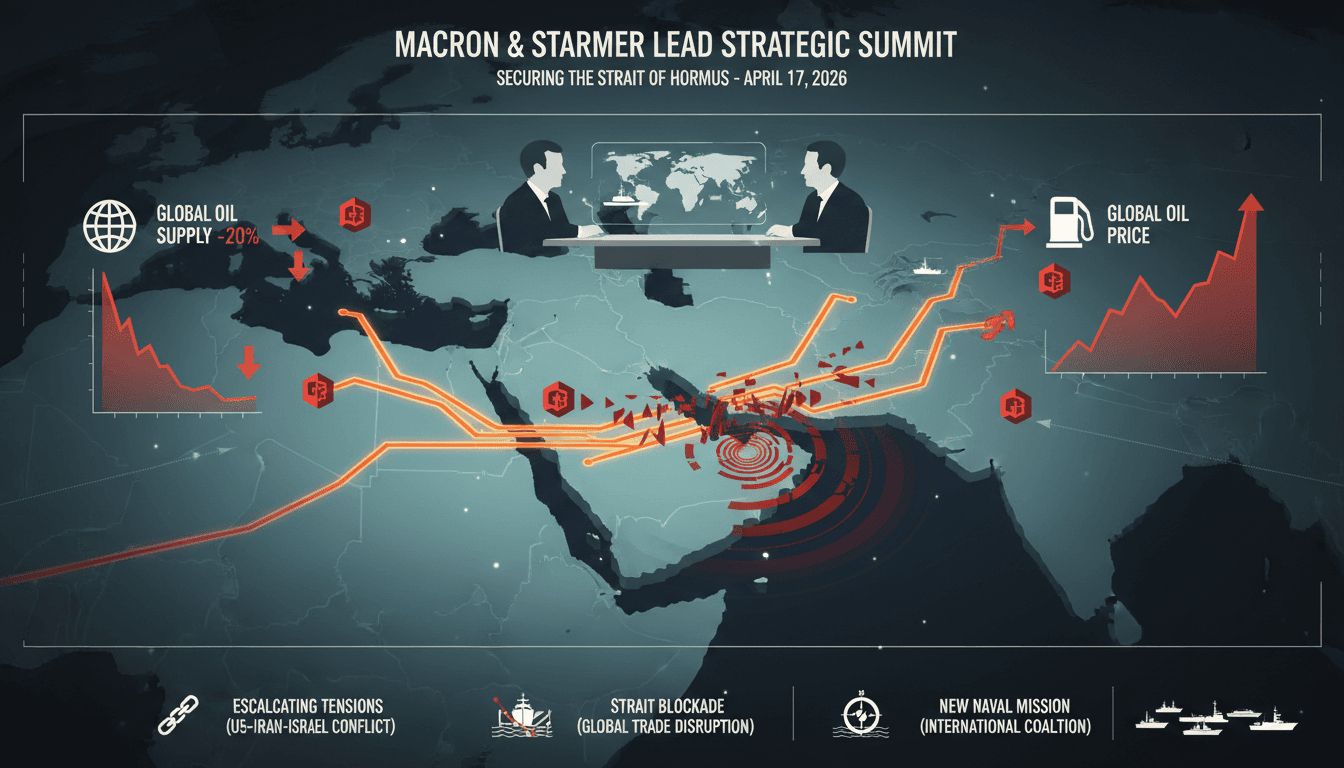
Here's what it means for you.
If you rely on global oil markets, the outcomes of this summit could directly impact your energy costs and supply stability.
Why it matters
The Strait of Hormuz is a critical chokepoint for global oil trade, and its security directly influences energy prices and economic stability worldwide.
What happened (in 30 seconds)
- On April 17, 2026, French President Emmanuel Macron and British Prime Minister Keir Starmer led a hybrid international summit to address the blockade of the Strait of Hormuz.
- Approximately 30 leaders participated, focusing on a defensive multinational mission to ensure freedom of navigation amid ongoing geopolitical tensions.
- Military planning chiefs are set to meet next week to discuss logistics for mine clearance and shipping escorts, excluding direct involvement from belligerent nations.
The context you actually need
- The crisis began on February 28, 2026, when US and Israeli airstrikes against Iran prompted a blockade of the Strait of Hormuz, disrupting a vital route for oil and gas exports.
- Iran's enforcement tactics included ship attacks, mine deployment, and tolls, leading to a near-total halt in tanker traffic and significant economic repercussions for Gulf producers.
- The summit aims to establish a "third way" between US pressure and renewed conflict, with participants seeking to reopen the strait while avoiding direct military confrontation.
What's really happening
The recent summit convened by Macron and Starmer is a response to the escalating crisis in the Strait of Hormuz, a strategic maritime corridor that facilitates the transit of approximately 20 million barrels of oil daily—accounting for 20% of global seaborne oil trade. The blockade initiated by Iran in late February 2026 has not only disrupted oil supplies but has also sent shockwaves through global energy markets, leading to soaring prices and heightened geopolitical tensions.
The summit's focus on a strictly defensive multinational mission underscores a collective desire among non-belligerent nations to restore stability without escalating military conflict. By excluding the US, Iran, and Israel from direct involvement, the initiative aims to create a neutral ground for dialogue and action. This approach reflects a growing recognition that unilateral military actions can exacerbate tensions rather than resolve them.
The economic implications of the blockade are profound. Gulf producers, particularly the UAE, have invoked force majeure, cutting production and relying on alternative pipelines to mitigate losses. The surge in fuel prices—up 33% in April 2026—has strained consumers and businesses alike, particularly in energy-dependent regions like Dubai. The reliance on bypass routes, such as the Abu Dhabi-Fujairah pipeline, highlights vulnerabilities in the supply chain that could be exploited in future conflicts.
As military chiefs prepare for their upcoming meeting in Northwood, the logistics of mine clearance and shipping escorts will be critical. The success of this mission hinges on the cooperation of various nations and the ability to navigate the complex geopolitical landscape. The summit participants have emphasized the need for unconditional reopening of the strait, which is essential for stabilizing energy prices and ensuring the flow of goods.
In summary, the summit represents a pivotal moment in international diplomacy, as nations seek to balance security concerns with economic realities. The outcomes will likely shape the future of energy markets and geopolitical relations in the region.
Who feels it first (and how)
- Energy consumers: Higher fuel prices and potential shortages could impact household budgets and business operations.
- Shipping companies: Increased war-risk insurance and operational costs due to heightened tensions in the region.
- Gulf producers: Economic strain from production cuts and reliance on alternative export routes, affecting revenue and market stability.
- Global markets: Volatility in oil prices could lead to broader economic implications, influencing inflation and trade dynamics.
What to watch next
- Military planning outcomes: The effectiveness of the proposed mine clearance and escort missions will determine the speed of reopening the strait and stabilizing oil prices.
- Geopolitical developments: Any shifts in US-Iran relations or further military actions could escalate tensions and impact global energy markets.
- Market reactions: Watch for fluctuations in Brent crude prices as the situation evolves, reflecting investor sentiment and supply chain stability.
The Strait of Hormuz is crucial for global oil trade, with 20 million barrels per day typically transiting the area.
The summit will lead to increased military cooperation among non-belligerent nations to secure the strait.
The long-term effectiveness of the proposed mission in mitigating geopolitical tensions and stabilizing energy markets remains uncertain.
Insights by A47 Intelligence
Regional and international reporting focused on Middle Eastern politics, diplomacy, and economics.
"Asharq Al-Awsat is a Saudi-owned international newspaper reflecting mainstream Gulf political perspectives."
— A47 Editor
Over a Dozen Countries Offer to Play Role in Hormuz Mission, Starmer Says
UK Prime Minister Keir Starmer announced that over a dozen countries have expressed willingness to participate in a mission to secure the Strait of Hormuz, a crucial maritime route for global oil transport. This development comes amid rising tensions...
Editor-curated FT homepage stories spanning markets, business, world, and opinion.
"The Financial Times is a globally respected business publication with a centrist/center-left tone and strong markets focus."
— A47 Editor
Macron and Starmer to hold summit on plan to secure Strait of Hormuz
French President Emmanuel Macron and UK Prime Minister Keir Starmer are set to hold a summit to discuss strategies for securing the Strait of Hormuz, a vital maritime route for global oil shipments, amid rising tensions in the region. This meeting is...
24/7 international news from a French perspective in multiple languages.
"France 24 is viewed as a globally focused outlet with balanced coverage and a European perspective."
— A47 Editor
Macron, Starmer rally allies to mull Hormuz mission
French President Emmanuel Macron and UK Prime Minister Keir Starmer convened a meeting of allies to discuss the potential deployment of a multinational force in the Strait of Hormuz, aimed at ensuring security and facilitating trade following the ong...
Regional coverage and analysis focused on politics, diplomacy, and business across the Middle East.
"Al-Monitor is known for analytical reporting on Middle East politics and policy developments."
— A47 Editor
Macron, Starmer rally allies to mull Hormuz mission
French President Emmanuel Macron and UK Prime Minister Keir Starmer convened a meeting of allies to discuss the potential deployment of a multinational force to secure the Strait of Hormuz, aiming to ensure the safety of maritime trade following the ...