
NASA's Curiosity Rover Discovers 21 Organic Molecules on Mars Including Seven Firsts
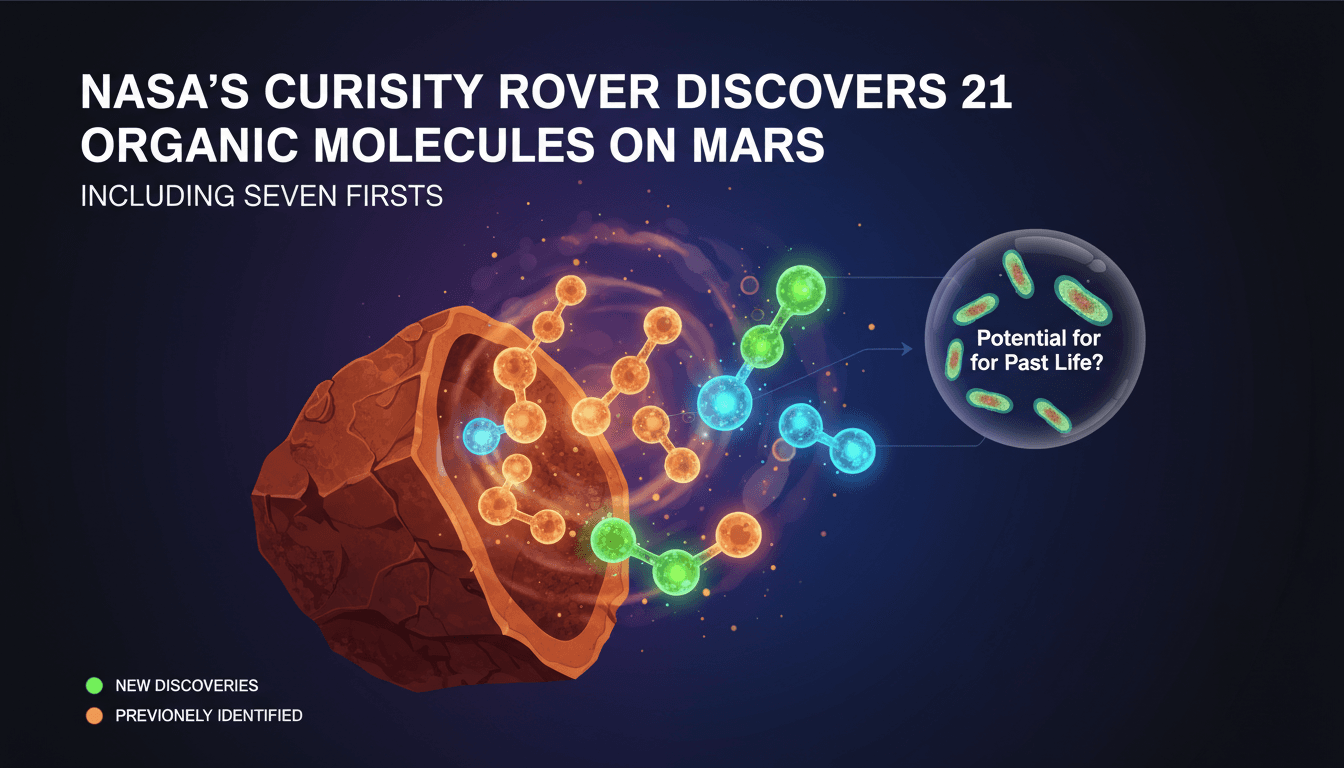
Here's what it means for you.
The detection of organic molecules on Mars could reshape our understanding of life beyond Earth, impacting scientific research and investment in space exploration.
Why it matters
This discovery enhances the potential for astrobiological research, influencing funding and interest in planetary science.
What happened (in 30 seconds)
- On April 21, 2026, NASA's Curiosity rover identified 21 organic molecules in a 3.5-billion-year-old rock sample from Gale Crater.
- Seven of these molecules were detected for the first time on Mars, including nitrogen heterocycles and benzothiophene.
- The findings, published in Nature Communications, bolster evidence that ancient Mars had the chemical ingredients necessary for life.
The context you actually need
- Curiosity's mission began in 2012, focusing on Mars' habitability through geological and chemical analysis, particularly in clay-rich areas formed by ancient lakes.
- Previous discoveries included simple organics in 2018 and larger hydrocarbons in 2025, setting the stage for this latest finding.
- The Sample Analysis at Mars (SAM) instrument utilized advanced wet chemistry techniques to analyze the rock sample, marking a significant step in extraterrestrial organic chemistry.
What's really happening
NASA's Curiosity rover has been a pivotal player in the quest to understand Mars' potential for life. Launched in 2012, it landed in Gale Crater, an area rich in geological history, on August 6 of the same year. The rover's mission has focused on analyzing the planet's surface and subsurface for signs of habitability, particularly in regions where ancient lakes and streams once existed.
The recent discovery of 21 carbon-containing organic molecules, including seven that had never been detected on Mars before, is a significant advancement in this ongoing research. The compounds identified include nitrogen heterocycles and benzothiophene, which are crucial for understanding the chemical processes that could support life. The analysis was conducted using the Sample Analysis at Mars (SAM) instrument, which employs a pioneering wet chemistry experiment. This method, utilizing tetramethylammonium hydroxide (TMAH), allows for the breakdown of larger organic molecules, enabling scientists to analyze complex compounds that were previously difficult to study.
The implications of these findings extend beyond mere curiosity. They suggest that ancient Mars had the necessary chemical ingredients for life, which could reshape our understanding of where and how life might arise in the universe. The scientific community has responded positively, recognizing the breakthrough as a significant step forward in biosignature detection techniques. Ashwin Vasavada, a project scientist at JPL, emphasized the potential for past life on Mars, igniting excitement and speculation about the origins of life beyond Earth.
Moreover, the timing of this announcement coincides with a growing interest in space exploration and astrobiology, particularly in regions like the UAE, where local initiatives such as the Mohammed bin Rashid Space Centre and the Hope Mars orbiter have heightened engagement with planetary science. This discovery could lead to increased collaboration and investment in astrobiological research, as nations and private entities seek to explore the potential for life on other planets.
Who feels it first (and how)
- Scientists and researchers in astrobiology and planetary science will likely see increased funding and interest in their work.
- Space agencies globally may ramp up missions to Mars and other celestial bodies to explore similar environments.
- Investors in the space sector could shift focus towards companies involved in planetary exploration and related technologies.
What to watch next
- Future Mars missions: Watch for announcements regarding new missions aimed at further exploring Martian geology and potential biosignatures, as they could build on Curiosity's findings.
- Funding shifts: Monitor changes in funding allocations for astrobiology research, particularly from governmental and private sectors, as interest in Mars' habitability grows.
- International collaborations: Look for increased partnerships between space agencies and universities focused on astrobiology, which could lead to innovative research and discoveries.
Curiosity has detected 21 organic molecules, including seven novel compounds on Mars.
Increased interest and funding in astrobiological research will follow this discovery.
The long-term implications for life on Mars and how this will influence future missions remain to be seen.
Insights by A47 Intelligence
Conservative-leaning political and national coverage.
"The Washington Times is a conservative-leaning newspaper known for its political coverage and advocacy of right-of-center viewpoints."
— A47 Editor
NASA rover finds organic molecules on Mars, suggesting it could have harbored life in distant past
NASA's Curiosity rover has discovered the most diverse collection of organic molecules ever found on Mars, indicating that the planet may have once had conditions suitable for supporting life. This significant finding was announced by scientists on T...
Tech industry news, innovation, gadgets, and startups from a UK broadcaster.
"Sky News is often seen as a center-right outlet in the UK, known for its rolling coverage and breaking stories."
— A47 Editor
Mars rover finds predecessor to DNA
NASA's Curiosity rover has made a significant discovery on Mars, identifying organic molecules that have never been detected before, suggesting the potential for past life on the planet. This finding was made after the rover drilled a rock sample fro...
Pan-Arab news coverage spanning politics, business, sports, and regional affairs.
"Asharq Al-Awsat reflects a broad Arab editorial perspective with strong attention to regional geopolitics."
— A47 Editor
مركبة متنقلة لـ«ناسا» تكتشف المزيد من لبنات الحياة على المريخ
Scientists announced on Tuesday that NASA's Curiosity rover has discovered additional building blocks of life on the surface of Mars. This finding adds to the ongoing exploration efforts to understand the planet's potential for supporting life.
Consumer technology news with AI coverage.
"Gadget and tech site reporting on AI in products."
— A47 Editor
NASA's Curiosity Rover found promising organic chemicals on Mars
NASA's Curiosity Rover has discovered promising organic chemicals on Mars during a groundbreaking wet chemistry experiment, indicating potential signs of life. This finding was published on April 21, 2026, and adds to the ongoing exploration of the G...
Covers consumer technology, electronics, gadgets, and product reviews.
"Engadget is a trusted source for gadget reviews and consumer tech news, known for its hands-on analysis and industry coverage."
— A47 Editor
NASA's Curiosity Rover found promising organic chemicals on Mars
NASA's Curiosity Rover has discovered promising organic chemicals on Mars during a groundbreaking wet chemistry experiment, indicating potential signs of life. This finding was published on April 21, 2026, and adds to the ongoing exploration of the G...
Reports on science policy, discoveries, and public debate in the scientific realm.
"The Guardian’s science section is known for thoughtful and critical reporting on global research, ethics, and public understanding of science."
— A47 Editor
‘Is it life? We can’t tell’: Nasa’s Curiosity rover finds organic molecules on Mars
NASA's Curiosity rover has detected organic molecules on Mars, including five previously unobserved chemicals in a dried lakebed near the equator, suggesting the presence of chemical building blocks of life that have been preserved for 3.5 billion ye...
Top international stories selected by The Guardian editors.
"The Guardian is known for its progressive editorial stance and in-depth analysis."
— A47 Editor
‘Is it life? We can’t tell’: Nasa’s Curiosity rover finds organic molecules on Mars
NASA's Curiosity rover has detected organic molecules on Mars, including five previously unobserved chemicals in a dried lakebed near the equator, suggesting the presence of chemical building blocks of life that have been preserved for 3.5 billion ye...
Space science news, astronomy updates, and spaceflight developments.
"Space.com delivers space science news, astronomy updates, and spaceflight developments with engaging coverage."
— A47 Editor
NASA's Curiosity rover finds building blocks of life on Mars. Scientists aren't sure how they got there
NASA's Curiosity rover has discovered a diverse array of organic molecules on Mars, which are considered essential building blocks for the origin of life on Earth. This finding raises intriguing questions about the potential for life beyond our plane...
News in science and technology, with a focus on consumer and innovation stories.
"Popular Science simplifies complex scientific topics for general audiences and celebrates innovation."
— A47 Editor
Curiosity finds molecules needed for ancient life on Mars
NASA's Curiosity rover has discovered organic molecules on Mars, suggesting the presence of chemical building blocks necessary for ancient life, potentially preserved for billions of years in Martian clay. This finding enhances the understanding of M...