
Saudi Business Confidence Index Declines to 52.1 Amid US-Israel-Iran Conflict
Here's what it means for you.
If you operate in or trade with Saudi Arabia, understanding these shifts in business confidence can help you navigate potential risks and opportunities.
Why it matters
The Saudi Business Confidence Index reflects broader economic stability and growth expectations, crucial for regional trade dynamics.
What happened (in 30 seconds)
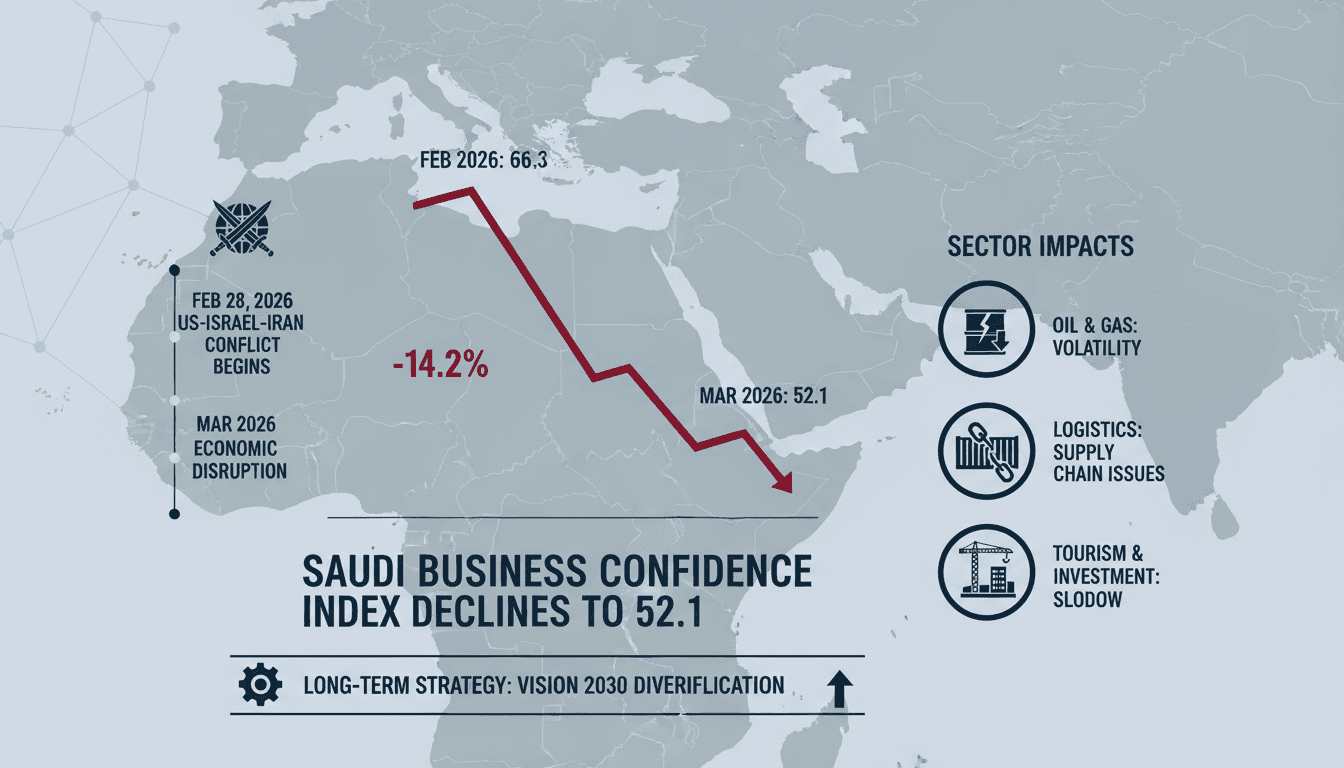
- The Saudi Business Confidence Index registered 52.1 points in March 2026, indicating optimism despite a 14.2% decline from February's 60.7 points.
- Geopolitical tensions from the US-Israel-Iran conflict, which began on February 28, have disrupted economic activities and market confidence.
- Sector-specific declines were noted, with industrial confidence at 50.8 points, services at 52 points, and construction at 53 points, all down from previous highs.
The context you actually need
- The index measures perceptions in non-oil sectors through monthly surveys of firms in industrial, services, and construction activities, providing a snapshot of economic sentiment.
- February's index was buoyed by stable conditions, but the onset of military conflict has shifted expectations and confidence levels significantly.
- Rising input costs and reduced confidence in sales and purchase orders have contributed to the overall decline, despite the index remaining above the neutral threshold of 50.
What's really happening
The Saudi Business Confidence Index, published by the General Authority for Statistics (GASTAT), serves as a vital barometer for the health of the non-oil private sector. In March 2026, the index fell to 52.1 points, a notable 14.2% drop from February's 60.7 points. This decline is particularly significant given the backdrop of escalating geopolitical tensions following the US-Israel airstrikes on Iran, which began on February 28, 2026.
The conflict has not only heightened regional instability but has also disrupted key economic activities, particularly in the energy markets and trade routes. As firms navigate this uncertain landscape, the decline in the index reflects a cautious approach to future investments and operational expansions. The survey results indicate that while there is still a baseline of optimism—evidenced by the index remaining above 50—confidence in current sales and purchase orders has waned. This suggests that businesses are bracing for potential downturns in demand and are adjusting their strategies accordingly.
Sector breakdowns reveal that the industrial sector saw the most significant drop, falling to 50.8 points, a decrease of 15.8%. The services sector followed closely at 52 points, down 14.9%, while construction held slightly better at 53 points, down 12.6%. These declines are primarily attributed to rising input costs, which have been exacerbated by the conflict's impact on supply chains. As firms face increased costs for materials and logistics, their ability to maintain previous levels of output and service quality is under pressure.
Despite these challenges, the report highlights a continued faith in the overall stability of economic activity and sector growth. This resilience is crucial for the Saudi economy, particularly as it aims to diversify away from oil dependency under its Vision 2030 initiative. However, the ongoing conflict poses significant risks to this trajectory, with potential ramifications for regional trade dynamics, particularly with neighboring GCC countries.
Who feels it first (and how)
- Manufacturers: Facing increased input costs and uncertainty in supply chains.
- Service providers: Experiencing reduced demand and cautious consumer spending.
- Construction firms: Adjusting project timelines and budgets due to rising costs.
- Investors: Monitoring market volatility and potential impacts on returns.
- Trade partners: Companies in Dubai and other GCC nations reliant on Saudi trade routes may see disruptions.
What to watch next
- Sector-specific performance: Monitoring how different sectors adapt to rising costs and shifting consumer demand will provide insights into economic resilience.
- Geopolitical developments: Any escalation or de-escalation in the US-Israel-Iran conflict will likely impact market confidence and operational stability.
- Input cost trends: Tracking changes in material costs and logistics will help gauge the ongoing impact of the conflict on business operations.
The Business Confidence Index declined to 52.1 points in March 2026.
Continued geopolitical tensions will further impact business confidence and operational costs.
The long-term effects of the conflict on Saudi Arabia's economic diversification efforts remain uncertain.
Insights by A47 Intelligence
English-language reporting on Saudi politics, policy, and society.
"Saudi Gazette reflects mainstream Saudi institutional perspectives."
— A47 Editor
Saudi Business Confidence Index shows optimism with 52 points despite geopolitical pressures
Saudi Arabia's Business Confidence Index recorded 52.1 points in March 2026, indicating continued optimism despite a 14.2% decline from February's 60.7 points, attributed to geopolitical pressures. The index remains above the neutral 50-point thresho...
English-language reporting focused on Saudi Arabia and regional affairs.
"Saudi Gazette provides English-language coverage that often aligns with mainstream Saudi news priorities."
— A47 Editor
Saudi Business Confidence Index shows optimism with 52 points despite geopolitical pressures
Saudi Arabia's Business Confidence Index recorded 52.1 points in March 2026, indicating continued optimism in the private sector despite a 14.2% decline from February's 60.7 points, attributed to ongoing geopolitical pressures. The index remains abov...
Pan-Arab news coverage spanning politics, business, sports, and regional affairs.
"Asharq Al-Awsat reflects a broad Arab editorial perspective with strong attention to regional geopolitics."
— A47 Editor
«مؤشر ثقة الأعمال» في السعودية يظهر حالة من التفاؤل رغم الضغوط الجيوسياسية
Recent data from the General Authority for Statistics indicates a decline in the Saudi Business Confidence Index in March, influenced by geopolitical tensions; however, it continues to reflect a sense of optimism.