
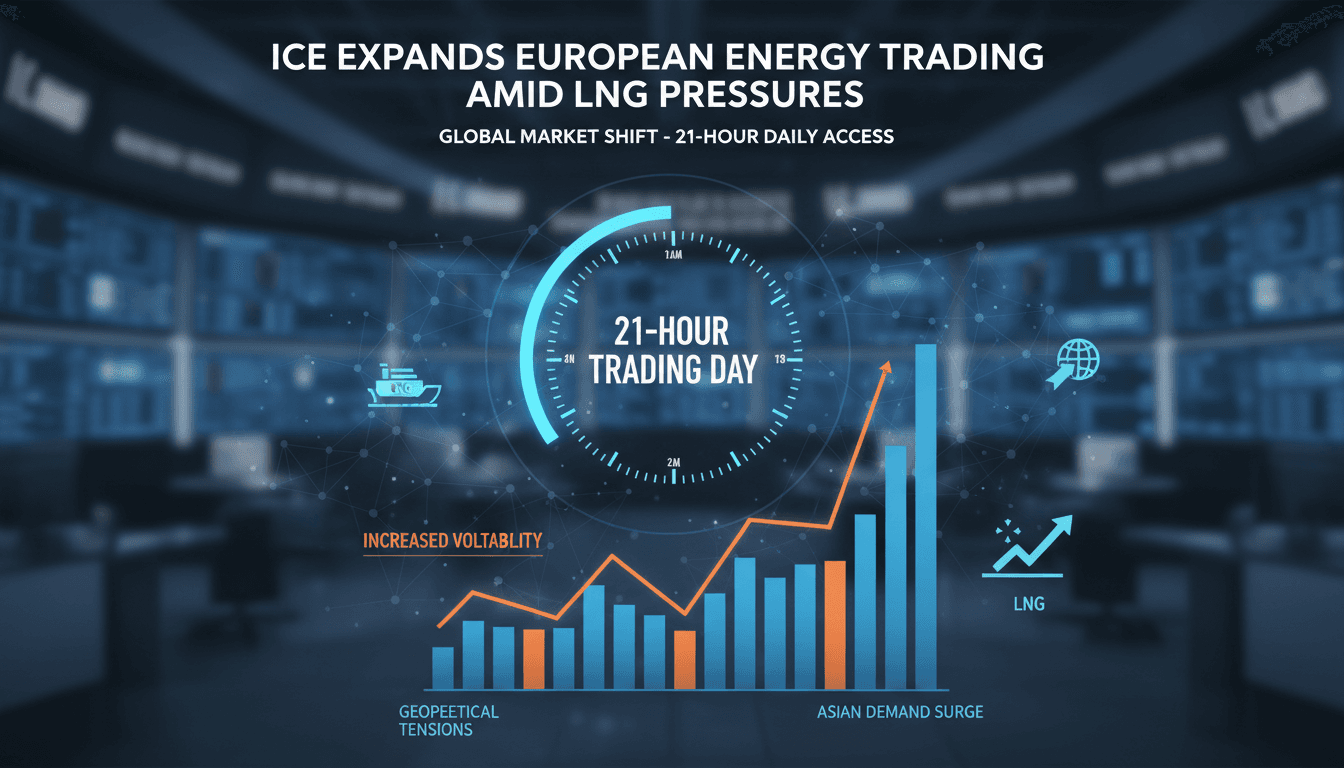
ICE Expands European Gas and Power Trading Hours to 21 Daily Amid LNG Market Pressures
Here's what it means for you.
If you’re involved in global energy markets, this shift could reshape your trading strategies and risk management.
Why it matters
This expansion reflects Europe's increasing reliance on global energy markets, impacting pricing and volatility across the board.
What happened (in 30 seconds)
- On April 11, 2026, the Intercontinental Exchange (ICE) announced an extension of trading hours for European gas and power futures to 21 hours daily, effective April 13, 2026.
- This change aligns European benchmarks like Dutch TTF with U.S. and Asian markets, facilitating global hedging amid rising LNG risks.
- Traders are preparing for operational strains and potential liquidity issues as the market adjusts to continuous trading.
The context you actually need
- Post-2022 shifts in Europe's energy landscape have increased dependency on liquefied natural gas (LNG) imports, making the market more sensitive to global supply chain disruptions.
- Initial plans for a 22-hour trading window were delayed due to operational complexities, leading to the current 21-hour schedule.
- Current market conditions show European gas contracts are nearly 40% above pre-conflict levels, indicating persistent volatility despite geopolitical developments.
What's really happening
The decision by ICE to extend trading hours for European gas and power futures is a strategic response to the evolving landscape of global energy markets. Since the onset of the Ukraine conflict in 2022, Europe has shifted from relying on Russian pipeline gas to sourcing liquefied natural gas (LNG) from various global suppliers. This transition has not only diversified supply sources but has also heightened Europe's exposure to international market dynamics, including U.S. export policies and competition from Asian markets.
The new trading hours, which will run from 22:50 London time on Sundays to 22:00 the following Monday, are designed to facilitate a more integrated global trading environment. By aligning European benchmarks like the Dutch TTF with U.S. Henry Hub and Asian hubs, traders can better hedge against price fluctuations that arise from geopolitical tensions or sudden shifts in demand. This continuous trading model aims to mitigate the risks associated with overnight news cycles, particularly those emerging from the U.S. and the Middle East, which have historically led to significant price swings.
However, this shift is not without its challenges. Traders are currently bracing for operational strains, as the extended hours may disrupt work-life balance and lead to thinned liquidity in the market. The concern is that while continuous trading can smooth out volatility, it may also expose traders to increased risks if liquidity dries up during off-peak hours. The market's ability to absorb these changes will be critical, especially as traders adapt to the new rhythm of trading.
Moreover, the broader implications of this shift extend beyond just the trading floor. As European energy markets become more intertwined with global dynamics, the potential for price shocks increases. This is particularly relevant for countries like the UAE, which has significant investments in European energy markets. The €38 billion in investments could be affected by fluctuations in LNG prices, which are now more closely tied to European trading hours.
In summary, the extension of trading hours is a reflection of the need for a more responsive and integrated global energy market. It represents a significant shift in how European energy is traded, moving from a regional utility focus to a global macro asset perspective.
Who feels it first (and how)
- Traders: Facing operational challenges and potential liquidity issues.
- Hedge funds and algorithmic traders: Adjusting strategies to capitalize on continuous trading opportunities.
- Energy companies: Navigating increased volatility and pricing pressures.
- UAE firms: Potentially benefiting from enhanced trading opportunities while facing increased import risks.
What to watch next
- Market liquidity: Monitor how liquidity holds up during the new trading hours, as thinned liquidity could lead to increased volatility.
- Geopolitical developments: Keep an eye on U.S. export policies and Middle East tensions, as these will directly impact European gas prices.
- Trader adaptation: Observe how traders adjust their strategies in response to the new trading environment, particularly concerning risk management.
The trading hours for European gas and power futures will be extended to 21 hours daily.
Increased volatility in European energy markets as traders adapt to continuous trading.
The long-term impact on liquidity and pricing stability in the European energy market.
Insights by A47 Intelligence
Market-moving headlines impacting equities, bonds, and related risk assets.
"Real-time catalysts and volatility drivers across indices and sectors."
— A47 Editor
21-hour trading: Europe expands energy window as LNG risks grow
Europe is expanding its energy trading window to 21 hours as risks associated with liquefied natural gas (LNG) supplies grow amid global market fluctuations. This adjustment reflects the continent's urgent need to secure energy resources in light of ...
Global markets, investing, and macroeconomics from a premier financial newsroom.
"Bloomberg is respected for in-depth financial reporting and data-driven analysis."
— A47 Editor
Europe Energy Traders Brace for 21-Hour Day as Volatility Surges
European gas and power markets are set to undergo a significant transformation as trading hours expand from 10 to 21, starting next week. This change reflects a response to increasing volatility and the need for more flexible trading options in the e...