
NASA's Artemis II Crew Sets New Distance Record for Human Spaceflight During Lunar Mission
Here's what it means for you.
The Artemis II mission's success could reshape investment opportunities and inspire new technological advancements in the space sector.
Why it matters
This milestone in human spaceflight signals a resurgence in global interest and investment in space exploration, impacting various industries.
What happened (in 30 seconds)
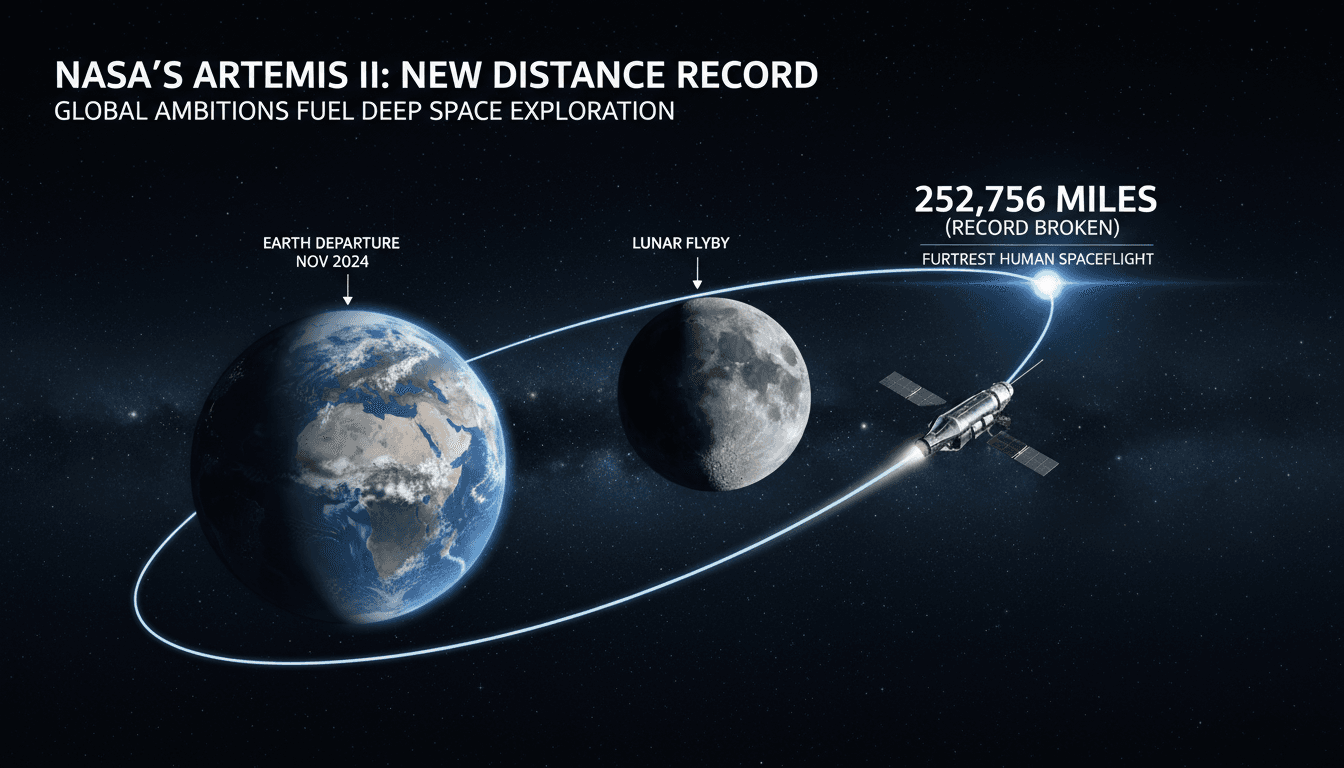
- On April 6, 2026, NASA's Artemis II crew surpassed the Apollo 13 distance record, traveling 252,756 miles from Earth during a lunar flyby.
- The crew, consisting of Reid Wiseman, Victor Glover, Christina Koch, and Jeremy Hansen, conducted geological observations of the Moon's far side.
- Splashdown is scheduled for April 10, 2026, off the coast of San Diego, marking the end of the first crewed lunar mission since 1972.
The context you actually need
- Artemis II is part of NASA's broader Artemis program, aimed at establishing a sustainable human presence on the Moon and preparing for future Mars missions.
- International collaboration is emphasized in this mission, with Canadian astronaut Jeremy Hansen aboard, showcasing a united front in space exploration.
- The mission's success has already led to a surge in space-related stocks, reflecting investor confidence in the future of space travel and exploration.
What's really happening
NASA's Artemis II mission represents a pivotal moment in the evolution of human spaceflight, breaking long-standing records and setting the stage for future lunar landings. Launched on April 1, 2026, the Orion spacecraft successfully executed a series of complex maneuvers, including a translunar injection burn that propelled it toward the Moon. The mission's crew conducted a flyby of the lunar far side on April 6, reaching a maximum distance of 252,756 miles from Earth, eclipsing the Apollo 13 record of 248,655 miles.
This achievement is not merely a technical milestone; it reflects a broader strategic shift in space exploration. The Artemis program aims to build on the legacy of the Apollo missions while addressing contemporary challenges and opportunities in space. The renewed focus on lunar exploration is driven by several factors, including geopolitical competition, technological advancements, and the potential for commercial opportunities in space.
As nations like China ramp up their lunar ambitions, the United States is positioning itself as a leader in international space collaboration. The inclusion of international astronauts, such as Hansen from Canada, underscores the importance of partnerships in achieving ambitious goals. This collaborative spirit is essential for addressing the complexities of deep space travel and establishing a sustainable presence on the Moon.
The Artemis II mission also serves as a testbed for the Space Launch System (SLS) rocket and Orion spacecraft, validating systems that will be critical for future missions, including Artemis III, which aims to land astronauts on the lunar surface. The data collected during this mission will inform future designs and operational strategies, enhancing safety and efficiency in space travel.
Moreover, the mission's success has immediate implications for the commercial space sector. Following the announcement of the distance record, stocks of space-related companies surged, indicating a growing investor appetite for ventures in this field. This trend suggests that the Artemis II mission could catalyze a new wave of investment and innovation, leading to advancements in technology, infrastructure, and services related to space exploration.
Who feels it first (and how)
- Investors in the space sector, who may see increased stock values and new opportunities.
- Aerospace companies involved in the Artemis program, benefiting from contracts and collaborations.
- Educational institutions and research organizations, which may receive funding and interest in space-related studies.
- Governments looking to enhance their own space programs, inspired by the success of Artemis II.
What to watch next
- Upcoming Artemis III mission: Scheduled for 2027, this mission will aim to land astronauts on the Moon, further validating the technologies tested in Artemis II.
- International collaborations: Watch for announcements regarding partnerships with other countries and private companies in upcoming missions.
- Investment trends: Monitor stock movements in space-related companies as the Artemis program progresses, indicating market confidence in the sector.
Artemis II successfully broke the human spaceflight distance record on April 6, 2026.
Increased investment and interest in space exploration technologies and companies.
The long-term impact of Artemis II on international space policy and cooperation.
Insights by A47 Intelligence
Reports on climate change, environmental science, sustainability, and nature.
"BBC News is widely regarded as a reputable international news organization, known for its impartial tone and public service mandate."
— A47 Editor
Artemis crew returning to Earth with 'all the good stuff' from Moon discoveries
The Artemis II crew has successfully completed their historic lunar flyby and is returning to Earth, bringing back a wealth of discoveries, including numerous photographs and stories from their journey around the Moon. The mission marks a significant...
International coverage of politics, culture, and current affairs.
"BBC News is widely regarded as a reputable international news organization, known for its impartial tone and public service mandate."
— A47 Editor
Artemis crew returning to Earth with 'all the good stuff' from Moon discoveries
The Artemis II crew has successfully completed their historic lunar flyby and is returning to Earth, bringing back a wealth of discoveries, including numerous photographs and stories from their journey around the Moon. The mission marks a significant...
National headlines across the United States including breaking stories and societal issues.
"NBC News is a mainstream media outlet known for comprehensive national and international news coverage with a centrist to slightly left-leaning editorial tone."
— A47 Editor
Artemis II crew reflects on mission ahead of return
The Artemis II crew, consisting of astronauts Jeremy Hansen, Christina Koch, Reid Wiseman, and Victor Glover, is set to return home after completing a historic lunar flyby on April 6, 2026, traveling farther from Earth than any humans before. This mi...
International news coverage curated for readers in the UAE and Gulf region.
"Emirates 24|7 world coverage presents global developments through a UAE-facing and Gulf-relevant editorial lens."
— A47 Editor
Artemis II astronauts prepare to end moon mission in 'fireball' re-entry Artemis II astronauts prepare to end moon mission in 'fireball' re-entry
NASA's Artemis II mission is nearing its conclusion as four astronauts prepare for re-entry to Earth after a historic lunar flyby, having launched on April 1, 2026. The crew, aboard the Orion capsule, experienced their first press conference from spa...
Reports on climate change, environmental science, sustainability, and nature.
"BBC News is widely regarded as a reputable international news organization, known for its impartial tone and public service mandate."
— A47 Editor
Artemis II is 'inspiring' a whole generation
NASA's Artemis II mission successfully launched on April 1, 2026, marking the first crewed lunar journey in over 50 years, with a crew of four astronauts aboard the Orion spacecraft. This mission is set to last ten days and aims to advance human expl...
Latest tech news, product reviews, and analysis for consumers and professionals.
"CNET delivers accessible and detailed technology reporting, including trusted product reviews and how-to guides."
— A47 Editor
Artemis II Astronauts Get Personal About Historic Mission
NASA's Artemis II mission, which successfully launched on April 1, 2026, marks a historic return to crewed lunar exploration with four astronauts aboard the Orion spacecraft. The crew is currently engaged in various tests and sharing insights about t...