
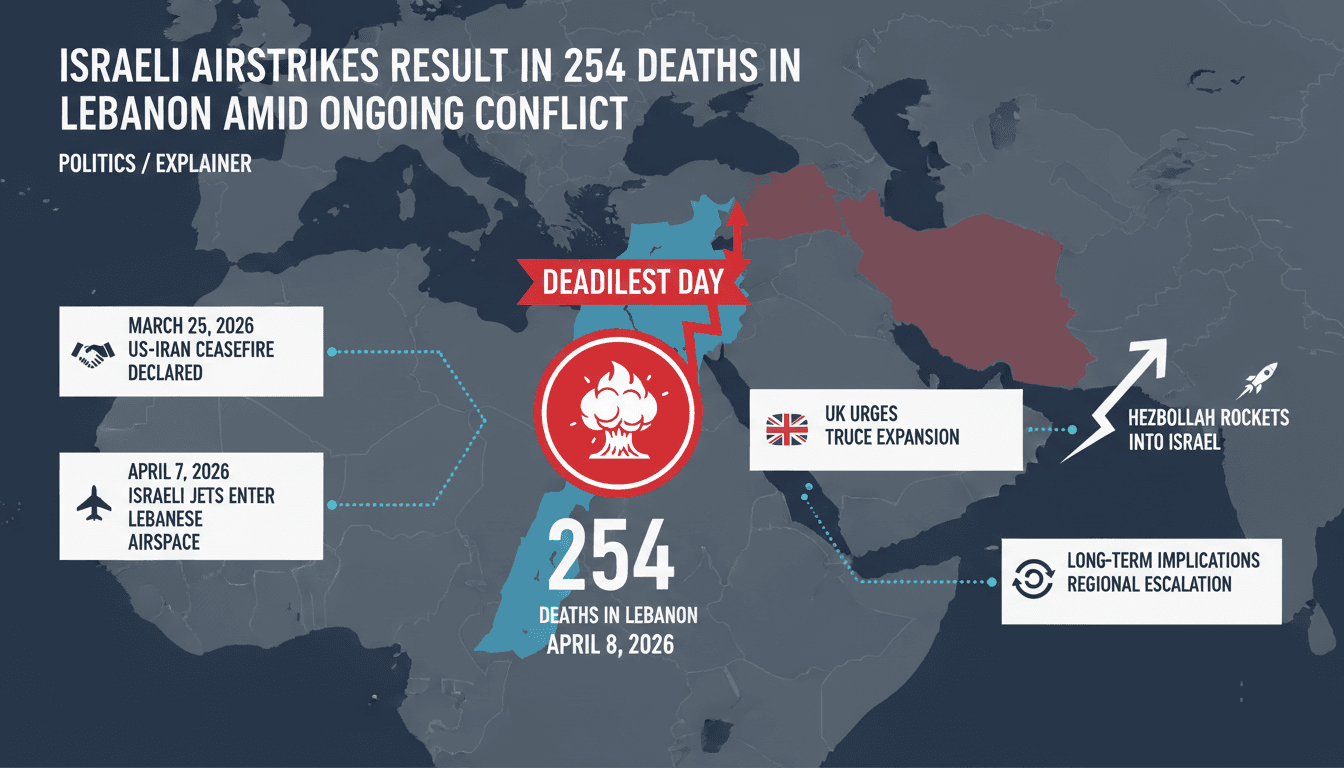
Israeli Airstrikes Result in 254 Deaths in Lebanon Amid Ongoing Conflict
Here's what it means for you.
The ongoing conflict in Lebanon could disrupt global markets and travel, impacting your investments and mobility.
Why it matters
The escalation in Lebanon threatens regional stability, which can have far-reaching economic implications globally.
What happened (in 30 seconds)
- Israeli airstrikes on April 8, 2026, killed at least 254 people in Lebanon, marking the deadliest day of the ongoing war with Hezbollah.
- Hezbollah resumed rocket attacks into northern Israel the following day, indicating a rapid escalation in hostilities.
- UK Foreign Secretary Yvette Cooper described the bombings as "extremely devastating" and called for the ceasefire to include Lebanon.
The context you actually need
- The 2026 Lebanon war began on March 2, 2026, after Hezbollah launched projectiles into Israel in support of Iran, following a US-Israeli attack on Iran.
- A fragile ceasefire was in place, mediated by Pakistan, but Israel claims it does not apply to Lebanon, leading to increased tensions.
- Over 1.2 million people have been displaced in Lebanon due to the conflict, exacerbating humanitarian crises and regional instability.
What's really happening
On April 8, 2026, Israel executed its largest coordinated airstrikes of the war, deploying 50 fighter jets to target over 100 Hezbollah sites across Lebanon. The strikes occurred shortly after Hezbollah paused its rocket attacks in observance of a fragile US-Iran ceasefire, which had been mediated by Pakistan. This timing suggests a strategic calculation by Israel to exploit Hezbollah's temporary restraint, aiming to deliver a decisive blow to the militant group.
The airstrikes targeted key command centers and military installations in Beirut, the Bekaa Valley, and southern Lebanon, resulting in significant casualties—254 reported dead and over 1,100 wounded. The strikes were characterized by their intensity, with multiple bombs dropped in rapid succession, particularly in densely populated areas of central Beirut, raising concerns about civilian casualties and humanitarian impacts.
In the aftermath, Hezbollah condemned the airstrikes as "barbaric" and resumed its rocket fire into northern Israel, demonstrating the immediate escalation of hostilities. Iranian officials threatened to withdraw from the ceasefire unless the attacks ceased, further complicating the geopolitical landscape. Israeli Prime Minister Netanyahu affirmed that military operations would continue, citing the exclusion of Hezbollah from the ceasefire agreement.
This situation is exacerbated by the already precarious humanitarian conditions in Lebanon, where over 1.2 million people have been displaced due to the ongoing conflict. The potential for a broader regional conflict is heightened, as the stakes involve not only Israel and Hezbollah but also the interests of Iran and the United States. The UK has urged for de-escalation, recognizing that the conflict could destabilize the entire region, with implications for global oil prices and security.
As the situation unfolds, the interconnectedness of global markets means that any significant escalation could lead to increased volatility, affecting everything from oil prices to international travel. The UAE, for instance, has a large Lebanese expatriate community that could face disrupted flights and regional travel restrictions, as seen in previous escalations.
Who feels it first (and how)
- Investors: Those with stakes in Middle Eastern markets may see volatility in stock prices and commodities.
- Travelers: Individuals planning to travel to or from Lebanon may face flight cancellations and increased travel restrictions.
- Expatriates: The Lebanese community, particularly in the UAE, may experience disruptions in their ability to connect with family and friends back home.
What to watch next
- Ceasefire negotiations: Watch for any developments in talks to include Lebanon in the US-Iran ceasefire, as this could stabilize or further escalate the situation.
- Hezbollah's military response: Monitor Hezbollah's military actions in response to Israeli strikes, as increased aggression could lead to broader conflict.
- Global oil prices: Keep an eye on fluctuations in oil prices, which could rise due to fears of regional instability affecting supply chains.
The airstrikes resulted in significant casualties and increased tensions between Israel and Hezbollah.
Continued military operations from both Israel and Hezbollah, with potential for further regional destabilization.
The long-term implications for US-Iran relations and how they will influence the conflict dynamics in Lebanon.
Insights by A47 Intelligence
Arabic-language coverage of political affairs and current events.
"Okaz political coverage typically follows mainstream Saudi framing on national and regional affairs."
— A47 Editor
250 قتيلًا في يوم.. بريطانيا: قصف إسرائيل للبنان «مدمر للغاية»
British Foreign Secretary Yvette Cooper described the Israeli bombardment of Lebanon as 'extremely devastating,' following airstrikes that resulted in over 250 fatalities in a single day. The escalation comes amid ongoing tensions between Israel and ...
Arabic-language UAE newspaper coverage focused on domestic affairs, public institutions, business, society, and regional developments.
"Al Khaleej coverage generally reflects a mainstream UAE editorial lens with strong attention to public affairs, institutions, and regional developments."
— A47 Editor
بريطانيا: نريد أن يشمل وقف إطلاق النار لبنان
British Foreign Secretary Yvette Cooper announced on Thursday that the UK strongly desires Lebanon to be included in the ceasefire agreement. This statement reflects the UK's ongoing diplomatic efforts to address regional conflicts and promote peace ...
International coverage from The Guardian's global desks.
"The Guardian is known for its progressive editorial stance and in-depth analysis."
— A47 Editor
Lebanon must be included in US-Iran ceasefire deal, Yvette Cooper to say
British Foreign Secretary Yvette Cooper is set to emphasize the necessity of including Lebanon in the ceasefire agreement between the US and Iran, as tensions escalate with ongoing Israeli airstrikes in Lebanon. This statement comes amid a fragile tw...
Regional coverage and analysis focused on politics, diplomacy, and business across the Middle East.
"Al-Monitor is known for analytical reporting on Middle East politics and policy developments."
— A47 Editor
Israel's pounding of Lebanon is 'deeply damaging', UK foreign minister says
British Foreign Secretary Yvette Cooper condemned Israel's recent airstrikes on Lebanon, describing them as 'deeply damaging' and calling for an end to hostilities to prevent destabilization of the region, particularly concerning the U.S.-Iran ceasef...