
KelpDAO LayerZero bridge exploit causes significant DeFi liquidity crisis
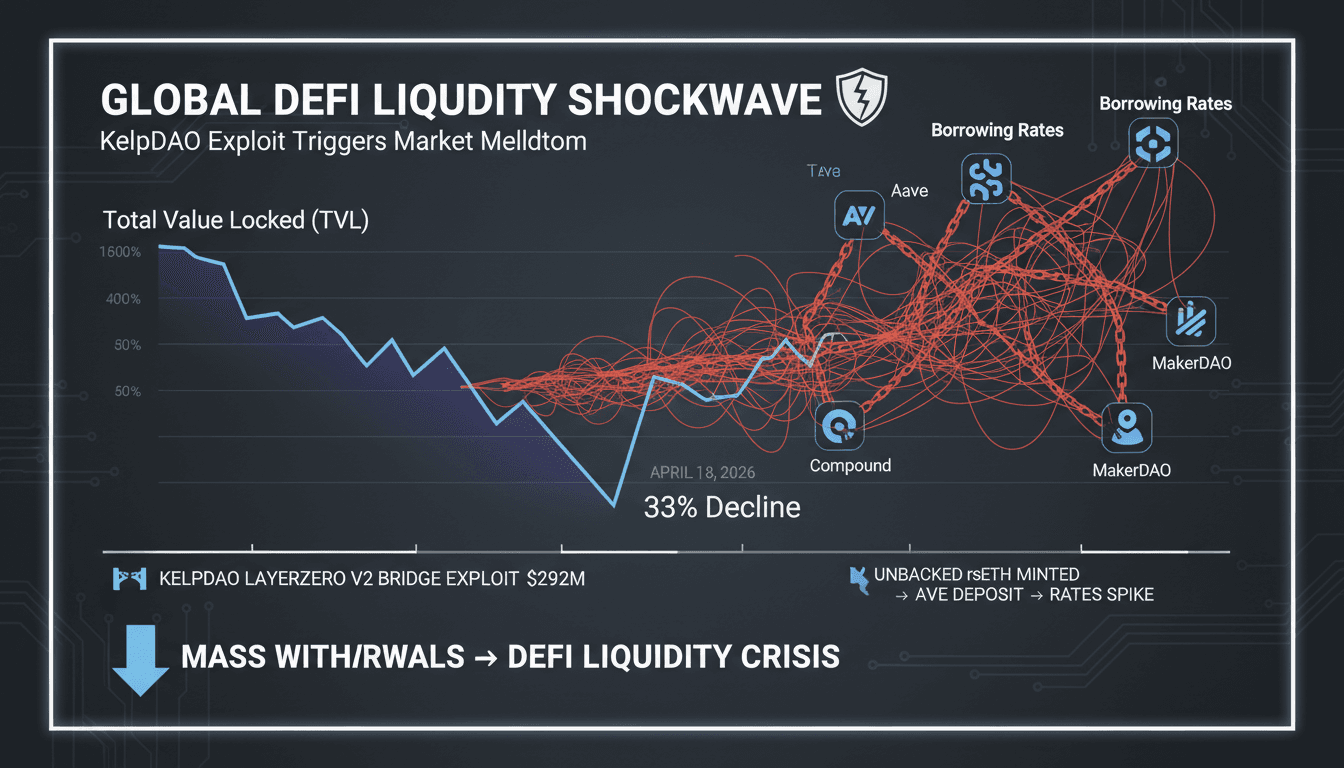
Here's what it means for you.
If you’re involved in decentralized finance (DeFi), this exploit could impact your liquidity options and borrowing costs.
Why it matters
This incident highlights vulnerabilities in DeFi protocols, potentially shaking investor confidence and liquidity across the sector.
What happened (in 30 seconds)
- KelpDAO was exploited on April 18, 2026, resulting in a loss of $292 million through its LayerZero V2 bridge.
- Aave's total value locked (TVL) dropped by 33% within 72 hours, leading to significant spikes in borrowing rates.
- CryptoQuant reported this as the most severe liquidity crunch since 2024, with Aave facing potential bad debt between $124 million and $230 million.
The context you actually need
- DeFi vulnerabilities have been on the rise in 2026, with multiple high-value exploits linked to North Korea's Lazarus Group.
- KelpDAO's rsETH token relied on a single Decentralized Verifier Network configuration, making it susceptible to manipulation and collateral depegging.
- Aave's aETHrsETH contract held 83% of the rsETH supply, amplifying the impact of the exploit on borrowing and liquidity.
What's really happening
On April 18, 2026, KelpDAO's LayerZero bridge was exploited, allowing attackers to mint 116,500 unbacked rsETH tokens valued at approximately $292 million. These tokens were subsequently deposited into Aave's aETHrsETH contract, which is crucial for liquidity in the DeFi ecosystem. Aave, a leading lending protocol, saw its total value locked (TVL) plummet from $45 billion to $30 billion—a staggering 33% decline within just 72 hours. This rapid contraction triggered a cascade of liquidity issues across various DeFi platforms.
The exploit's ramifications were immediate and severe. Borrowing rates for ETH surged to 8%, the highest level since January 2024, while rates for stablecoins like USDT and USDC skyrocketed from 3.4% to 14%. The overall supply of USDe diminished by $800 million, representing a 14% drop. CryptoQuant's analysis, released on April 22, documented this liquidity crisis as the most acute since 2024, indicating systemic vulnerabilities within the DeFi landscape.
In response to the exploit, Aave published an incident report via Llamarisk, modeling potential bad debt scenarios ranging from $124 million to $230 million. The protocol froze rsETH markets and partially unfroze WETH to stabilize operations. Meanwhile, Arbitrum's Security Council took action to immobilize $71 million in funds linked to the attackers. The hackers managed to launder approximately $175 million in ETH into 442 BTC, further complicating recovery efforts.
The AAVE token, which serves as a governance and utility token for the Aave protocol, depreciated by 18–20% in the wake of the exploit. Aggregate outflows from DeFi protocols exceeded $10 billion, reflecting a broader loss of confidence in the sector. Notably, no centralized governmental interventions were recorded, leaving the DeFi ecosystem to navigate this crisis independently.
This incident underscores the fragility of DeFi protocols, particularly those relying on single points of failure. As the market stabilizes, the focus will shift to how protocols manage bad debt and restore liquidity, as well as the potential for regulatory scrutiny in the wake of such exploits.
Who feels it first (and how)
- DeFi investors: Those holding assets in affected protocols may face increased borrowing costs and reduced liquidity options.
- Lending platforms: Protocols like Aave will need to address bad debt and restore user confidence, impacting their operational strategies.
- Crypto traders: Increased volatility and liquidity issues may affect trading strategies and market positions.
- Regulatory bodies: Heightened scrutiny on DeFi protocols could lead to new regulations aimed at preventing future exploits.
What to watch next
- Bad debt resolution: Monitor how Aave and other affected protocols manage and resolve bad debt, as this will influence market confidence.
- Market recovery indicators: Watch for signs of liquidity restoration and stabilization in borrowing rates across DeFi platforms.
- Regulatory developments: Keep an eye on potential regulatory responses to this exploit, which could reshape the DeFi landscape.
KelpDAO suffered a $292 million exploit, leading to a significant liquidity contraction in DeFi.
Aave will face challenges in managing bad debt and restoring user confidence in the wake of the exploit.
The long-term regulatory implications for DeFi protocols remain uncertain as the market reacts to this incident.
Insights by A47 Intelligence
Covers Bitcoin plus altcoin news, market updates, and educational resources.
"Bitcoin.com provides news, market data, and guides focused on Bitcoin and the wider crypto industry."
— A47 Editor
Cryptoquant: KelpDAO Hack ‘Contagion’ Triggers Worst DeFi Liquidity Crunch Since 2024
The KelpDAO hack has triggered a severe liquidity crisis in decentralized finance (DeFi), marking the worst liquidity crunch since 2024. The exploit resulted in a staggering loss of approximately $292 million, leading to significant financial repercu...
Bitcoin news, technical analysis, and forecasts across crypto markets.
"NewsBTC covers Bitcoin news, technical analysis, and forecasts across crypto markets and major blockchain projects."
— A47 Editor
DeFi Just Lost $15 Billion in Three Days. Something Deeper Than a Hack Is Behind It
The decentralized finance (DeFi) sector has faced a severe crisis, losing approximately $15 billion in just three days due to a significant exploit at Kelp DAO. The incident began on April 19 when an attacker exploited a flaw in the protocol's collat...
Real-time updates, analysis, and reports on the blockchain and cryptocurrency sectors.
"Crypto News delivers real-time updates, analysis, and reports on the blockchain and cryptocurrency sectors."
— A47 Editor
The $290 Million KelpDAO Hack Linked to North Korea Wiped $13 Billion From DeFi in Two Days
A significant security breach on KelpDAO's cross-chain bridge on April 18 resulted in a loss of approximately $290 million, attributed to North Korea's Lazarus Group. This exploit triggered a massive downturn in the decentralized finance (DeFi) secto...
Bitcoin news, technical analysis, and forecasts across crypto markets.
"NewsBTC covers Bitcoin news, technical analysis, and forecasts across crypto markets and major blockchain projects."
— A47 Editor
Aave Is Down 18% And Carrying $196M In Bad Debt, But Smart Money Is Buying Anyway
Aave has faced a significant downturn, with an 18% drop in its token value following a $292 million exploit of KelpDAO's rsETH bridge, which resulted in approximately $196 million in bad debt. This incident has led to a massive withdrawal crisis, wit...
Research, news, and analysis on blockchain startups, DeFi, and regulations.
"Crypto Briefing provides research, news, and analysis on blockchain startups, DeFi, and crypto regulations with investor-focused coverage."
— A47 Editor
$293M DeFi exploit hits Kelp/AAVE, raises systemic risk concerns
A significant exploit of the Kelp restaking platform has resulted in a loss of approximately $293 million, raising systemic risk concerns within the decentralized finance (DeFi) sector. This incident highlights the vulnerabilities present in DeFi pla...
Covers blockchain, cryptocurrency news, project analysis, and market insights.
"CoinDesk is a well-established cryptocurrency and blockchain news provider, offering comprehensive insights, market data, and industry research."
— A47 Editor
KelpDAO hackers are laundering millions in stolen crypto, data show
KelpDAO hackers are reportedly laundering $290 million in stolen cryptocurrency across various blockchains, utilizing privacy tools to obscure their activities amidst growing concerns of contagion within the decentralized finance (DeFi) sector.
Bitcoin news, technical analysis, and forecasts across crypto markets.
"NewsBTC covers Bitcoin news, technical analysis, and forecasts across crypto markets and major blockchain projects."
— A47 Editor
AAVE Price Plummets By 26%: $9 Billion Net Outflows Traced To Kelp DAO Hack
A significant hack of the Kelp DAO, which drained approximately $292 million, has led to a 26% drop in the price of AAVE, the native token of the Aave protocol. This incident has resulted in a staggering $280 million in bad debt for Aave, as the stol...
Covers blockchain, cryptocurrency news, project analysis, and market insights.
"Cointelegraph is a leading crypto-focused media outlet known for timely news, analysis, and educational content related to blockchain and digital assets."
— A47 Editor
Aave risk manager models 2 bad debt scenarios from Kelp DAO exploit
Aave's risk management team has modeled two potential bad debt scenarios following the recent exploit of Kelp DAO, which resulted in significant financial losses. The first scenario, while less expensive, poses a risk of a 15% depegging of rsETH, whi...
Research, news, and analysis on blockchain startups, DeFi, and regulations.
"Crypto Briefing provides research, news, and analysis on blockchain startups, DeFi, and crypto regulations with investor-focused coverage."
— A47 Editor
KelpDAO exploit exposes $290M in unbacked assets, AAVE freezes rsETH markets
The KelpDAO exploit has exposed approximately $290 million in unbacked assets, leading to AAVE freezing its rsETH markets. This incident highlights significant vulnerabilities within decentralized finance (DeFi) platforms, raising alarms about their ...