
UN Security Council Rejects Bahrain's Resolution for Strait of Hormuz Security Amid Major Powers' Vetoes
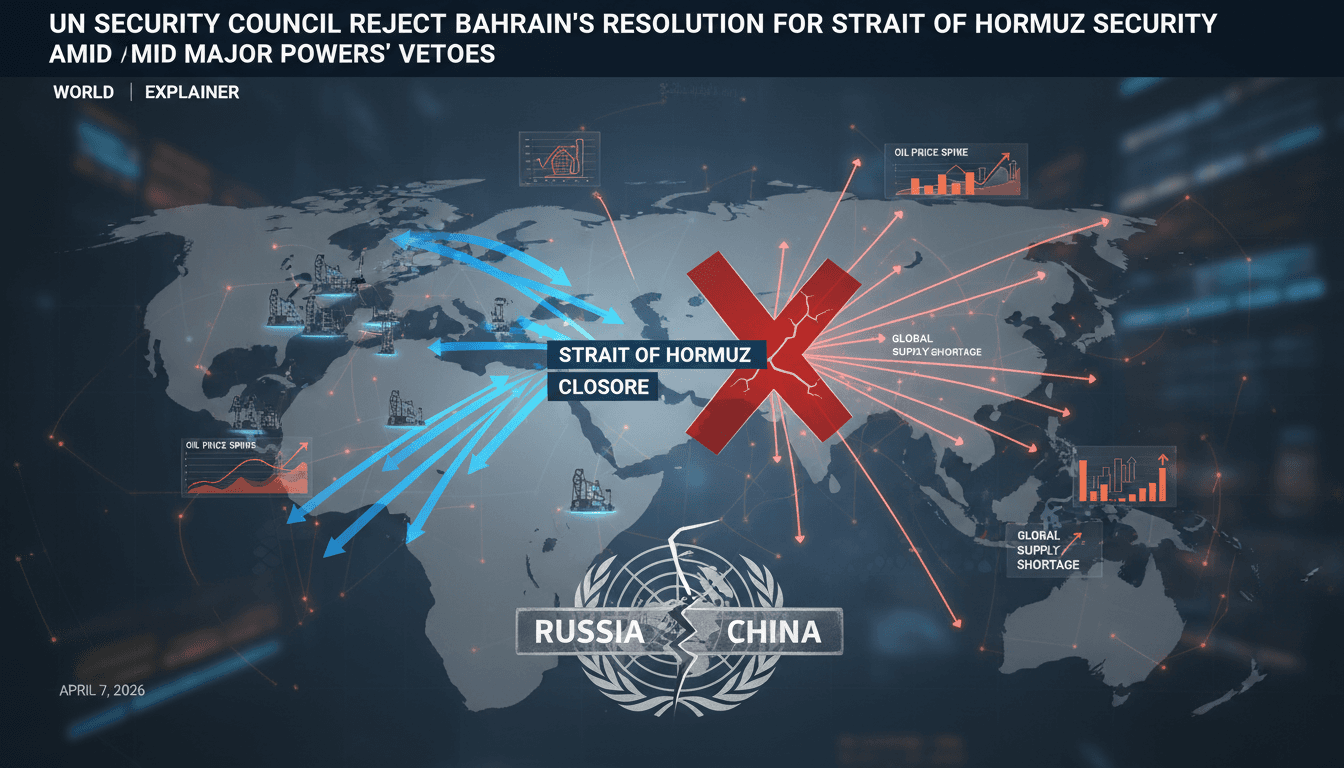
Here's what it means for you.
If you rely on global oil markets or shipping routes, the recent UN veto could lead to increased costs and supply chain disruptions.
Why it matters
The Strait of Hormuz is a critical chokepoint for global oil and LNG trade, and its instability directly impacts energy prices and shipping logistics worldwide.
What happened (in 30 seconds)
- On April 7, 2026, the UN Security Council voted on a Bahrain-sponsored resolution aimed at enhancing security for commercial shipping in the Strait of Hormuz.
- Russia and China vetoed the resolution, citing bias against Iran and a failure to address root causes of the conflict.
- As of April 9, 2026, the Strait remains largely closed, significantly affecting global oil transit and escalating regional tensions.
The context you actually need
- The Strait of Hormuz handles approximately 20% of the world's oil and LNG trade, making its security vital for global energy markets.
- Iran closed the strait in late February 2026 following U.S. and Israeli military actions, escalating a regional conflict that has now lasted over six weeks.
- Previous resolutions have faced challenges, with Bahrain's initial draft evolving from an aggressive stance to a more defensive one to appease vetoing powers.
What's really happening
The recent veto by Russia and China on the Bahrain-sponsored resolution for Strait of Hormuz security underscores the complexities of international diplomacy in a volatile region. The strait, a crucial maritime passage, is responsible for transporting about 20% of the world's oil and liquefied natural gas. Its closure, initiated by Iran in response to U.S. and Israeli military strikes, has led to a significant reduction in vessel transits—plummeting from 130 to just 6 daily. This drastic decline not only threatens global energy supplies but also raises shipping costs and insurance premiums, particularly for countries like the UAE, which co-sponsored the resolution.
The failure to adopt the resolution highlights a broader geopolitical struggle. Russia and China, both permanent members of the UN Security Council, have vested interests in opposing U.S. influence in the region. Their vetoes reflect a strategic alignment with Iran, which they perceive as a counterbalance to Western hegemony. The French vote in favor of the resolution, despite earlier reservations, illustrates the divisions among the permanent members and the challenges of achieving a unified stance on Middle Eastern conflicts.
Bahrain's attempt to dilute the resolution from an offensive to a defensive posture indicates an understanding of the delicate balance required to navigate the interests of major powers. However, the ultimate rejection suggests that even well-intentioned efforts to stabilize the region can be thwarted by geopolitical rivalries. The ramifications are significant: heightened tensions in the Gulf, increased oil prices, and potential disruptions to humanitarian aid efforts in conflict zones like Gaza and Sudan.
As the situation evolves, the reliance on ad-hoc naval protections and unilateral actions by nations may become more pronounced. The U.S. has already indicated a willingness to take unilateral measures, which could further escalate tensions. The ongoing conflict and the strait's closure are likely to strain trade-dependent economies, particularly in the Gulf region, where energy prices are already on the rise.
Who feels it first (and how)
- Dubai residents: Facing elevated fuel and energy prices due to increased shipping costs and delays.
- Shipping companies: Experiencing heightened insurance costs and logistical challenges in navigating the strait.
- Global consumers: Likely to see rising prices for goods as supply chains are disrupted.
- Energy markets: Oil prices are expected to surge as uncertainty around supply increases.
What to watch next
- Shipping traffic levels: Monitor the number of vessels transiting the Strait of Hormuz to gauge the impact on global oil supply.
- Oil price fluctuations: Watch for changes in crude oil prices as markets react to ongoing tensions and supply chain disruptions.
- U.S. military actions: Keep an eye on any unilateral actions by the U.S. or allied nations in response to the strait's closure, which could escalate regional conflicts.
The Strait of Hormuz is critical for global oil and LNG trade, with its closure impacting energy prices.
Shipping costs and insurance premiums will rise as a result of the ongoing conflict and strait closure.
The long-term geopolitical implications of the veto and its impact on U.S.-Iran relations.
Insights by A47 Intelligence
Global business headlines with AI angles.
"General business outlet that frequently covers AI."
— A47 Editor
Why UN Security Council Failed to Act on Strait of Hormuz: Russia, China and France's Triple Resistance Exposed
Russia and China vetoed a UN Security Council resolution concerning the Strait of Hormuz, following resistance from France that weakened the proposed text. This decision highlights the complexities and challenges within the UN Security Council regard...
Arabic-language UAE newspaper coverage focused on domestic affairs, public institutions, business, society, and regional developments.
"Al Khaleej coverage generally reflects a mainstream UAE editorial lens with strong attention to public affairs, institutions, and regional developments."
— A47 Editor
واشنطن تندد باستخدام روسيا والصين الفيتو ضد قرار مضيق هرمز
On Tuesday, China and Russia exercised their veto power against a Bahraini draft resolution at the United Nations that aimed to encourage countries to coordinate efforts to protect maritime navigation in the Strait of Hormuz. The U.S. ambassador to t...
News from the United States including domestic politics, society, and culture.
"Global News is a mainstream Canadian media outlet generally considered to have a centrist editorial stance, covering news with a focus on factual reporting and national interest."
— A47 Editor
Russia, China veto UN Security Council measure to reopen Strait of Hormuz
Russia and China vetoed a U.N. Security Council resolution aimed at reopening the Strait of Hormuz, a vital maritime route for global oil shipments, after the proposal was modified to remove authorization for military action. This decision reflects o...
International coverage of politics, security, and social issues.
"Global News is a mainstream Canadian outlet with a centrist editorial stance, focusing on factual reporting."
— A47 Editor
Russia, China veto UN Security Council measure to reopen Strait of Hormuz
Russia and China vetoed a U.N. Security Council resolution aimed at reopening the Strait of Hormuz, a vital maritime route for global oil shipments, after the proposal was modified to remove authorization for military action. This decision reflects o...
Regional and international reporting focused on Middle Eastern politics, diplomacy, and economics.
"Asharq Al-Awsat is a Saudi-owned international newspaper reflecting mainstream Gulf political perspectives."
— A47 Editor
Russia and China Veto Watered-Down UN Resolution Aimed at Reopening the Strait of Hormuz
On April 7, 2026, Russia and China vetoed a United Nations Security Council resolution aimed at reopening the Strait of Hormuz, a critical maritime route for global oil shipments. The resolution, proposed by Bahrain and supported by the United States...
English-language reporting on Saudi politics, policy, and society.
"Saudi Gazette reflects mainstream Saudi institutional perspectives."
— A47 Editor
Russia, China veto UN resolution on Hormuz navigation security
The UN Security Council's attempt to adopt a resolution aimed at ensuring freedom of navigation in the Strait of Hormuz was thwarted on Tuesday when Russia and China exercised their veto power. The Bahrain-drafted resolution garnered 11 votes in favo...
UAE-based English-language newspaper covering regional politics, economics, and global affairs.
"The National reflects Emirati policy perspectives while maintaining international editorial standards."
— A47 Editor
Russia and China block UN resolution calling for reopening of Strait of Hormuz
On April 7, 2026, Russia and China vetoed a United Nations Security Council resolution aimed at reopening the Strait of Hormuz, a crucial maritime route for global oil shipments. The resolution, proposed by Bahrain and backed by the United States, ga...