
Kelp DAO suffers $293 million exploit impacting DeFi and traditional banking strategies
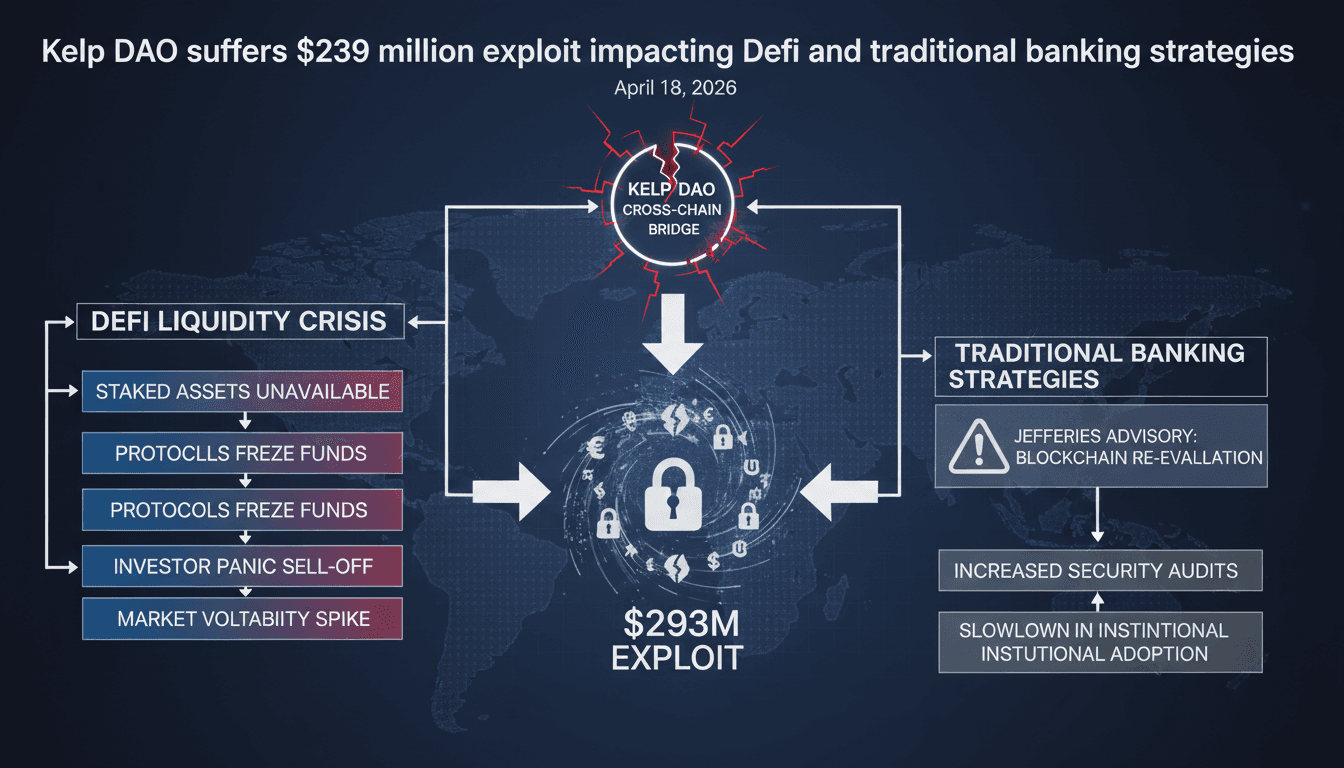
Here's what it means for you.
If you’re involved in finance or tech, this incident could reshape how institutions approach blockchain projects.
Why it matters
This exploit highlights critical vulnerabilities in decentralized finance (DeFi) systems, potentially delaying traditional banks' blockchain initiatives.
What happened (in 30 seconds)
- On April 18, 2026, Kelp DAO suffered a $293 million exploit due to a vulnerability in its cross-chain bridge.
- Attackers minted 116,500 unbacked rsETH tokens, using them to borrow assets from platforms like Aave, leading to significant liquidity issues.
- Jefferies analyst Andrew Moss warned that this incident could cause major banks to rethink their blockchain strategies due to infrastructure risks.
The context you actually need
- April 2026 was the worst month for crypto exploits, with over $606 million lost across various incidents, including Kelp DAO and Drift Protocol.
- Traditional finance institutions were ramping up blockchain engagement, focusing on asset tokenization and stablecoin applications, driven by regulatory advancements.
- The exploit revealed single points of failure in cross-chain verification, raising concerns about the security of decentralized systems.
What's really happening
On April 18, 2026, Kelp DAO, a decentralized finance protocol, experienced a significant breach when attackers exploited a vulnerability in its LayerZero-powered cross-chain bridge. This breach allowed them to mint 116,500 unbacked rsETH tokens, amounting to a staggering $293 million. The attackers then used these tokens as collateral to borrow assets from various lending platforms, including Aave, which faced approximately $200 million in bad debt as a result.
The exploit triggered a liquidity crisis across the DeFi ecosystem, leading to a contraction of total value locked (TVL) by $9-14 billion within just 48 hours. Kelp DAO acted swiftly, pausing contracts 46 minutes after the exploit, but the damage was already done. Major platforms like Aave and SparkLend halted trading of rsETH, further exacerbating the liquidity issues.
Jefferies analyst Andrew Moss highlighted the broader implications of this incident, suggesting that traditional financial institutions might reconsider their blockchain initiatives due to the immature infrastructure that allowed such a significant exploit to occur. This warning comes at a time when banks were increasingly exploring blockchain technology for asset tokenization and stablecoin applications, driven by recent regulatory advancements and infrastructure improvements.
The exploit also raised suspicions about the involvement of North Korea's Lazarus Group, known for its sophisticated cyberattacks. As investigations continue, the attacker has been laundering the stolen funds through various channels, including THORChain to Bitcoin and Tron USDT, complicating recovery efforts.
The Kelp DAO incident serves as a stark reminder of the vulnerabilities inherent in decentralized finance systems. As traditional finance (TradFi) institutions look to adopt blockchain technology, the risks highlighted by this exploit could lead to increased scrutiny and potentially delayed projects as security audits become a priority.
Who feels it first (and how)
- DeFi investors: Facing significant losses and liquidity issues.
- Lending platforms like Aave: Confronting bad debt exposure and operational challenges.
- Traditional banks: Reassessing blockchain initiatives due to heightened security concerns.
- Regulatory bodies: Under pressure to enhance oversight and security measures in the crypto space.
What to watch next
- Increased security audits: Expect banks and financial institutions to prioritize security assessments for blockchain projects, impacting timelines.
- Regulatory developments: Watch for new regulations aimed at enhancing security in DeFi, which could reshape the landscape.
- Market recovery indicators: Monitor how quickly DeFi platforms recover their TVL and investor confidence post-exploit.
The Kelp DAO exploit resulted in a $293 million loss and significant liquidity issues across DeFi platforms.
Traditional banks will delay blockchain projects to reassess security measures and infrastructure.
The long-term impact on investor confidence in DeFi and how quickly the ecosystem can recover.
Insights by A47 Intelligence
Covers blockchain, cryptocurrency news, project analysis, and market insights.
"CoinDesk is a well-established cryptocurrency and blockchain news provider, offering comprehensive insights, market data, and industry research."
— A47 Editor
The $292 million Kelp DAO exploit shows why crypto bridges are still one of the industry's weakest links
The Kelp DAO suffered a major exploit, resulting in the loss of approximately $292 million from its LayerZero-powered bridge, with 116,500 rsETH drained, which constitutes about 18% of the circulating supply. This incident has raised serious concerns...
Covers blockchain, cryptocurrency news, project analysis, and market insights.
"CoinDesk is a well-established cryptocurrency and blockchain news provider, offering comprehensive insights, market data, and industry research."
— A47 Editor
Crypto's massive exploit may force big banks to rethink their blockchain plans, Jefferies warns
The Kelp DAO suffered a significant exploit, resulting in approximately $293 million being drained from its reserves due to vulnerabilities in its LayerZero-powered bridge. This incident has raised alarms regarding the security of decentralized finan...
Real-time updates, analysis, and reports on the blockchain and cryptocurrency sectors.
"Crypto News delivers real-time updates, analysis, and reports on the blockchain and cryptocurrency sectors."
— A47 Editor
Kelp DAO exploit fallout deepens as attacker routes $175M in ETH via privacy rails
The Kelp DAO has suffered a significant exploit, resulting in approximately $290 million drained from its reserves, with the attacker now moving $175 million in Ether through various wallet addresses to obscure the stolen funds. This breach has raise...
Bitcoin news, technical analysis, and forecasts across crypto markets.
"NewsBTC covers Bitcoin news, technical analysis, and forecasts across crypto markets and major blockchain projects."
— A47 Editor
A $292M Hack Created $200M In Bad Debt On Aave: Here Is What That Means For Users
Aave is grappling with a significant crisis following a $292 million hack that exploited a vulnerability in Kelp's bridge, leading to the creation of approximately $200 million in bad debt on its platform. The exploit allowed attackers to use stolen ...
News and analysis on Bitcoin, altcoins, and blockchain innovation.
"Bitcoinist delivers news and analysis on Bitcoin, altcoins, and blockchain innovation with a focus on market trends and industry updates."
— A47 Editor
What The Kelp DAO’s $292 Million Hack Means For XRP Holders Earning Yield
A significant security breach occurred at Kelp DAO over the weekend, where an attacker exploited the LayerZero-powered bridge, resulting in the loss of approximately $292 million in tokens. This incident marks one of the largest hacks in decentralize...
Real-time updates, analysis, and reports on the blockchain and cryptocurrency sectors.
"Crypto News delivers real-time updates, analysis, and reports on the blockchain and cryptocurrency sectors."
— A47 Editor
Kelp DAO blames LayerZero defaults for $290m rsETH bridge disaster
Kelp DAO has attributed a significant security breach, resulting in a loss of approximately $290 million from its rsETH bridge, to LayerZero's default single-validator setup. This incident has sparked a blame game between Kelp DAO and LayerZero, with...
Covers blockchain, cryptocurrency news, project analysis, and market insights.
"Cointelegraph is a leading crypto-focused media outlet known for timely news, analysis, and educational content related to blockchain and digital assets."
— A47 Editor
Kelp exploit highlights problem with non-isolated DeFi lending: Crypto execs
The Kelp restaking platform has experienced a significant security breach, resulting in a loss of approximately $293 million due to an exploit involving rsETH. This incident has raised alarms within the decentralized finance (DeFi) sector, highlighti...
News and analysis on Bitcoin, altcoins, and blockchain innovation.
"Bitcoinist delivers news and analysis on Bitcoin, altcoins, and blockchain innovation with a focus on market trends and industry updates."
— A47 Editor
Kelp DAO Suffers $292 Million rsETH Exploit – Details
Kelp DAO has experienced a significant security breach, with approximately $292 million drained from its reserves due to an exploit involving 116,500 rsETH. This incident raises serious concerns about the security of the protocol, especially followin...