
U.S. and Iran Reach Two-Week Ceasefire Amid Oil Price Collapse and Stock Market Surge
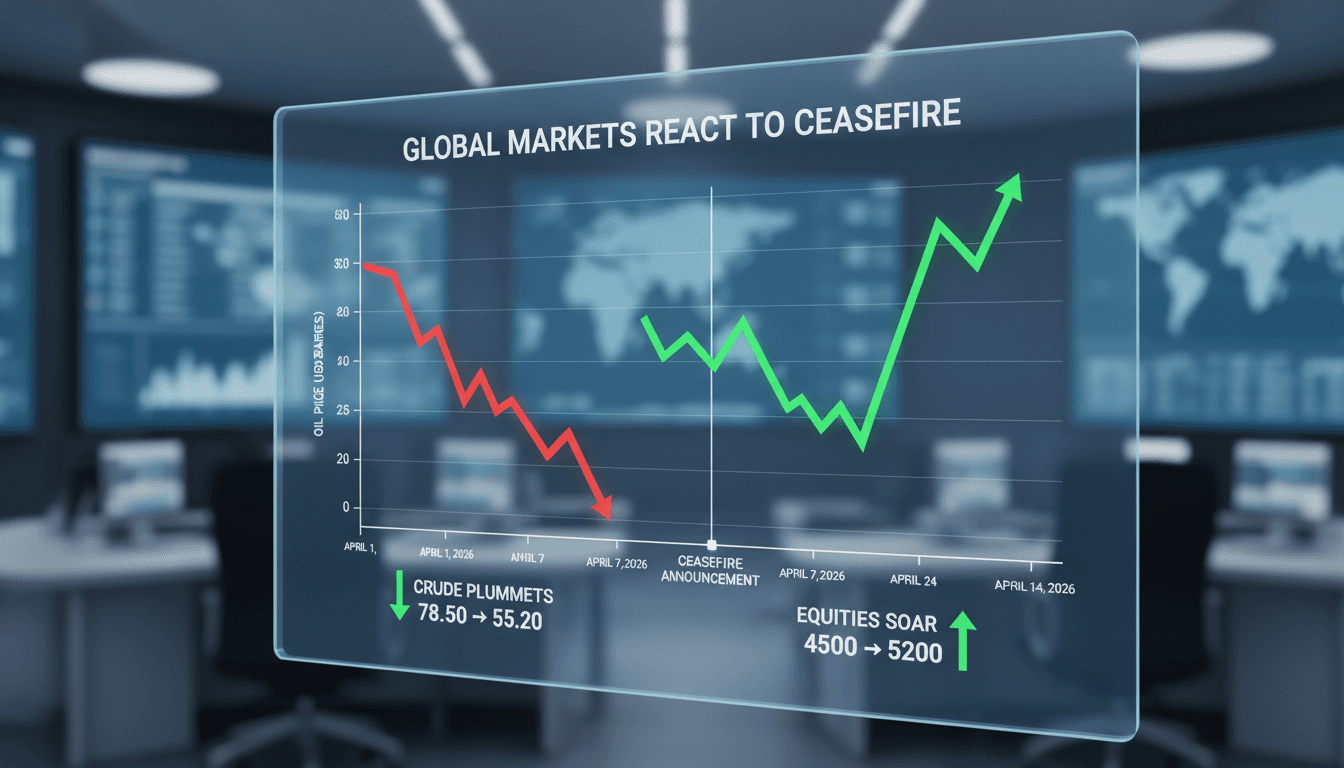
Here's what it means for you.
If you’re invested in global markets or energy sectors, the recent ceasefire could significantly impact your portfolio.
Why it matters
This ceasefire has the potential to stabilize global oil prices and restore investor confidence, affecting markets and economies worldwide.
What happened (in 30 seconds)
- U.S. and Iran announced a conditional two-week ceasefire on April 7, 2026, just before a critical deadline set by President Trump.
- The ceasefire led to a record surge in U.S. stocks on April 8, with the Dow Jones rising 1,325 points (2.8%) while oil prices plummeted 16%.
- Negotiations for a longer-term resolution are scheduled in Pakistan, indicating a potential shift in regional dynamics.
The context you actually need
- The conflict began six weeks prior when U.S. and Israeli forces targeted Iranian assets, leading to the closure of the Strait of Hormuz, a critical oil shipping route.
- This disruption caused a significant oil supply shock, inflating prices above $100 per barrel and pressuring global markets.
- The ceasefire was mediated by Pakistan, highlighting its role as a key player in regional diplomacy.
What's really happening
The recent ceasefire between the U.S. and Iran marks a pivotal moment in a conflict that has had far-reaching implications for global markets and energy supplies. The Strait of Hormuz, through which 20% of the world's oil passes, had been effectively closed by Iran in response to military actions from the U.S. and Israel. This closure led to a dramatic spike in oil prices, which surged above $100 per barrel, causing widespread inflationary pressures and significant volatility in equity markets.
As tensions escalated, President Trump set an ultimatum for Iran to reopen the Strait by 8 p.m. ET on April 7, 2026. The announcement of a ceasefire just 90 minutes before this deadline was a calculated move that not only averted further military escalation but also restored a degree of stability to the global oil market. The immediate market reaction was overwhelmingly positive, with the Dow Jones Industrial Average gaining 1,325 points (2.8%) on April 8, the largest single-day increase since April 2025. This surge reflects investor optimism and a collective sigh of relief as fears of a prolonged conflict subsided.
The ceasefire is conditional upon Iran's compliance with reopening the Strait of Hormuz, which it has already begun to do by allowing limited ship transits. This reopening is critical, as it will ease the supply constraints that have plagued the market for weeks. The decline in oil prices, with West Texas Intermediate crude futures dropping 16% to $94.41 per barrel, signals a return to more manageable energy costs, which is crucial for both consumers and businesses globally.
However, the situation remains fragile. While the ceasefire is a positive step, unresolved issues persist, including Iran's uranium enrichment activities and ongoing tensions with Israel. The upcoming negotiations in Pakistan, led by Vice President JD Vance, will be critical in determining whether this ceasefire can evolve into a more lasting peace agreement. The geopolitical landscape is still volatile, and any misstep could reignite tensions and disrupt markets once again.
Who feels it first (and how)
- Investors in U.S. equities: Benefiting from the stock market surge and increased investor confidence.
- Energy sector stakeholders: Experiencing volatility as oil prices drop, impacting revenue forecasts.
- Consumers globally: Likely to see relief from rising energy costs, which could ease inflationary pressures.
- Middle Eastern economies: Particularly those reliant on oil exports, will feel the impact of fluctuating oil prices and potential stability.
What to watch next
- Iran's compliance with the ceasefire: Monitoring how quickly and effectively Iran reopens the Strait of Hormuz will be crucial for market stability.
- Negotiations in Pakistan: The outcomes of these talks will indicate whether a longer-term resolution can be achieved, affecting geopolitical stability.
- Global oil price trends: Continued fluctuations in oil prices will impact inflation rates and economic growth projections worldwide.
The ceasefire has led to an immediate positive reaction in global stock markets.
Oil prices will stabilize if the Strait of Hormuz remains open, benefiting global economies.
The long-term sustainability of the ceasefire and its impact on regional tensions.
Insights by A47 Intelligence
Arabic-language UAE newspaper coverage focused on domestic affairs, public institutions, business, society, and regional developments.
"Al Khaleej coverage generally reflects a mainstream UAE editorial lens with strong attention to public affairs, institutions, and regional developments."
— A47 Editor
ارتفاعات حادة في وول ستريت وأسواق أوروبا وآسيا بدعم وقف إطلاق النار
U.S. stocks closed sharply higher on Wednesday following a last-minute two-week ceasefire agreement between the United States and Iran, which boosted investor sentiment. This development reflects a significant shift in market dynamics, as geopolitica...
Markets desk coverage, trading insights, and investor updates.
"WSJ’s markets reporting provides in-depth analysis and context for investors."
— A47 Editor
Stocks Jump After U.S., Iran Walk Back From the Brink
U.S. stock markets experienced a significant rebound, with the Dow industrials rising 2.8%, marking its largest gain since spring, while the S&P 500 and Nasdaq composite extended their winning streak to six days. This surge follows a period of height...
Real-time updates, analysis, and reports on the blockchain and cryptocurrency sectors.
"Crypto News delivers real-time updates, analysis, and reports on the blockchain and cryptocurrency sectors."
— A47 Editor
U.S. stocks surge as Iran‑US ceasefire sparks tech‑led relief rally
U.S. stocks experienced a significant surge following the announcement of a two-week ceasefire between the United States and Iran, with the Dow rising 2.76%, the S&P 500 increasing by 2.64%, and the Nasdaq climbing 3.5%. This tech-led rally reflects ...
International coverage of politics, security, and social issues.
"Global News is a mainstream Canadian outlet with a centrist editorial stance, focusing on factual reporting."
— A47 Editor
Wall Street surges, oil prices plunge on ‘fragile truce’ of Iran ceasefire
Oil prices fell below $95 per barrel and global stock markets surged following U.S. President Donald Trump's announcement of a two-week ceasefire with Iran, marking a significant de-escalation in ongoing tensions. This truce is contingent upon Iran's...
Global business headlines with AI angles.
"General business outlet that frequently covers AI."
— A47 Editor
Dow Futures Surge Over 1,000 Points as Oil Tumbles on Trump Iran Ceasefire
U.S. stock futures surged over 1,000 points early Wednesday following President Donald Trump's announcement of a two-week ceasefire with Iran, contingent on the reopening of the Strait of Hormuz. This announcement led to a significant drop in oil pri...
Business, markets, economy, and corporate news with strong UAE and regional relevance.
"Emirates 24|7 business coverage tends to center UAE markets, property, regulation, and regional economic developments."
— A47 Editor
Asian benchmarks jump after oil prices sink in response to the Iran ceasefire Asian benchmarks jump after oil prices sink in response to the Iran ceasefire
Asian stock markets experienced a significant surge following the announcement of a two-week ceasefire between the United States and Iran, which includes the reopening of the strategically vital Strait of Hormuz. Japan's Nikkei 225 rose by 5.0%, whil...
Global markets, investing, and macroeconomics from a premier financial newsroom.
"Bloomberg is respected for in-depth financial reporting and data-driven analysis."
— A47 Editor
Stocks Gain as US-Iran Truce Deal Spurs Oil Plunge: Markets Wrap
A wave of optimism has swept through global financial markets following the announcement of a two-week ceasefire agreement between the United States and Iran, which has led to a significant rally in stocks and cryptocurrencies while causing oil price...