
Moonshot AI Launches Kimi K2.6 Model Surpassing Major Competitors
Here's what it means for you.
The launch of Kimi K2.6 could redefine your access to advanced AI tools, impacting productivity and innovation across industries.
Why it matters
This release signals a significant shift in the AI landscape, democratizing access to powerful models that were previously proprietary.
What happened (in 30 seconds)
- On April 20, 2026, Moonshot AI released the Kimi K2.6 model, an open-weight large language model.
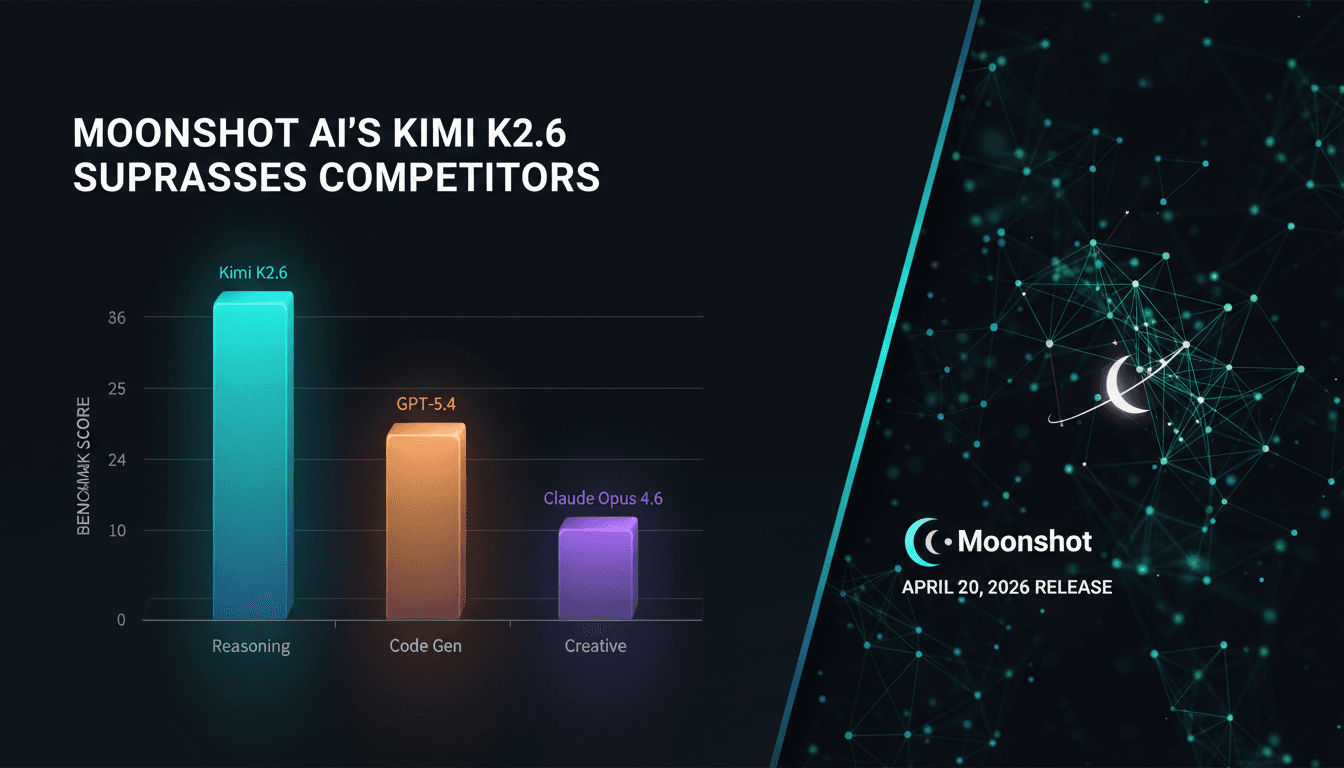
- It achieved a score of 58.6% on the SWE-Bench Pro coding benchmark, outperforming OpenAI's GPT-5.4 and Anthropic's Claude Opus 4.6.
- The model supports agent swarms with up to 300 sub-agents, enabling extensive autonomous task execution.
The context you actually need
- Moonshot AI began developing the Kimi series in October 2023 amid rising Sino-US AI competition, aiming to close the gap with proprietary models.
- Kimi K2.6 is part of a series that has progressively improved open-weight capabilities, focusing on long-context reasoning and agentic tasks.
- The Mixture-of-Experts architecture allows for specialized training, enhancing the model's performance in sustained execution scenarios.
What's really happening
The release of Kimi K2.6 marks a pivotal moment in the AI industry, particularly in the realm of open-source models. By achieving parity with leading proprietary models like OpenAI's GPT-5.4 and Anthropic's Claude Opus 4.6, Moonshot AI is not just showcasing technological prowess but also challenging the existing market dynamics. The Kimi K2.6 model, with its 1 trillion parameters and 32 billion activated parameters, utilizes a Mixture-of-Experts architecture that allows it to activate only the necessary parameters for a given task. This efficiency is crucial for handling complex tasks, as it enables the model to perform at a high level while managing computational resources effectively.
The model's ability to support agent swarms—up to 300 sub-agents executing over 4,000 coordinated steps—opens new avenues for automation and efficiency in various sectors. This capability is particularly relevant for industries that rely on extensive data processing and task automation, such as software development, database management, and multimodal operations. The extended autonomy allows for 12+ hour runs, which can significantly enhance productivity and reduce the time required for complex projects.
Moreover, the decision to release Kimi K2.6 under a modified MIT license on platforms like Hugging Face emphasizes a commitment to open-source principles, potentially accelerating innovation across the AI community. This move could lead to a broader adoption of AI technologies, as developers and businesses can leverage the model without the constraints typically associated with proprietary software. The implications are profound: as more organizations gain access to advanced AI capabilities, the competitive landscape will shift, favoring those who can effectively integrate these tools into their operations.
However, this democratization of AI also raises questions about the ethical use of such powerful technologies. As the barriers to entry lower, the potential for misuse increases, necessitating a dialogue around responsible AI deployment. The AI community is already responding positively, with developers praising Kimi K2.6 for its long-horizon coherence and open-source parity, indicating a strong interest in integrating this model into existing workflows.
Who feels it first (and how)
- AI Developers: They will benefit from enhanced tools for building and deploying autonomous agents.
- Tech Startups: Access to advanced AI capabilities can accelerate innovation and product development.
- Large Enterprises: Companies in sectors like software development and data management will see improved efficiency and reduced operational costs.
- Educational Institutions: They can leverage the model for research and training, enhancing learning outcomes in AI and machine learning.
- Government Agencies: Potential applications in public services and data analysis could improve operational effectiveness.
What to watch next
- Adoption Rates: Monitor how quickly businesses and developers integrate Kimi K2.6 into their workflows, as this will indicate its impact on productivity.
- Community Feedback: Pay attention to developer reactions and use cases shared on platforms like Hugging Face, which will reveal the model's strengths and weaknesses in real-world applications.
- Regulatory Responses: Watch for any emerging guidelines or regulations regarding the use of open-weight AI models, as this could shape the future landscape of AI deployment.
Kimi K2.6 has been released and is publicly available for use.
Increased adoption of open-weight models will lead to a more competitive AI landscape.
The long-term implications of widespread access to powerful AI tools on ethical standards and regulatory frameworks.
This article was generated by AI from 2 verified sources and reviewed by A47 editorial systems.
Daily AI news: models, tools, and policy.
"Independent outlet tracking the fast pace of AI."
— A47 Editor
Open-weight Kimi K2.6 takes on GPT-5.4 and Claude Opus 4.6 with agent swarms
Moonshot AI has launched Kimi K2.6, an open-weight AI model designed to compete with OpenAI's GPT-5.4 and Anthropic's Claude Opus 4.6, capable of running up to 300 agents in parallel for coding tasks. This release marks a significant step in the ongo...
Curated tech headlines including AI stories.
"Influential aggregator surfacing the day’s top tech/AI links."
— A47 Editor
Moonshot introduces Kimi K2.6, an open-weight model that it says shows strong improvements in long-horizon coding tasks, available under a modified MIT License (Kimi AI)
Moonshot has introduced Kimi K2.6, an open-weight AI model that demonstrates significant improvements in long-horizon coding tasks. This model is now available under a modified MIT License, emphasizing the company's commitment to open-source developm...