
Netanyahu Confirms Ongoing Military Strikes Against Hezbollah Amid US-Iran Ceasefire
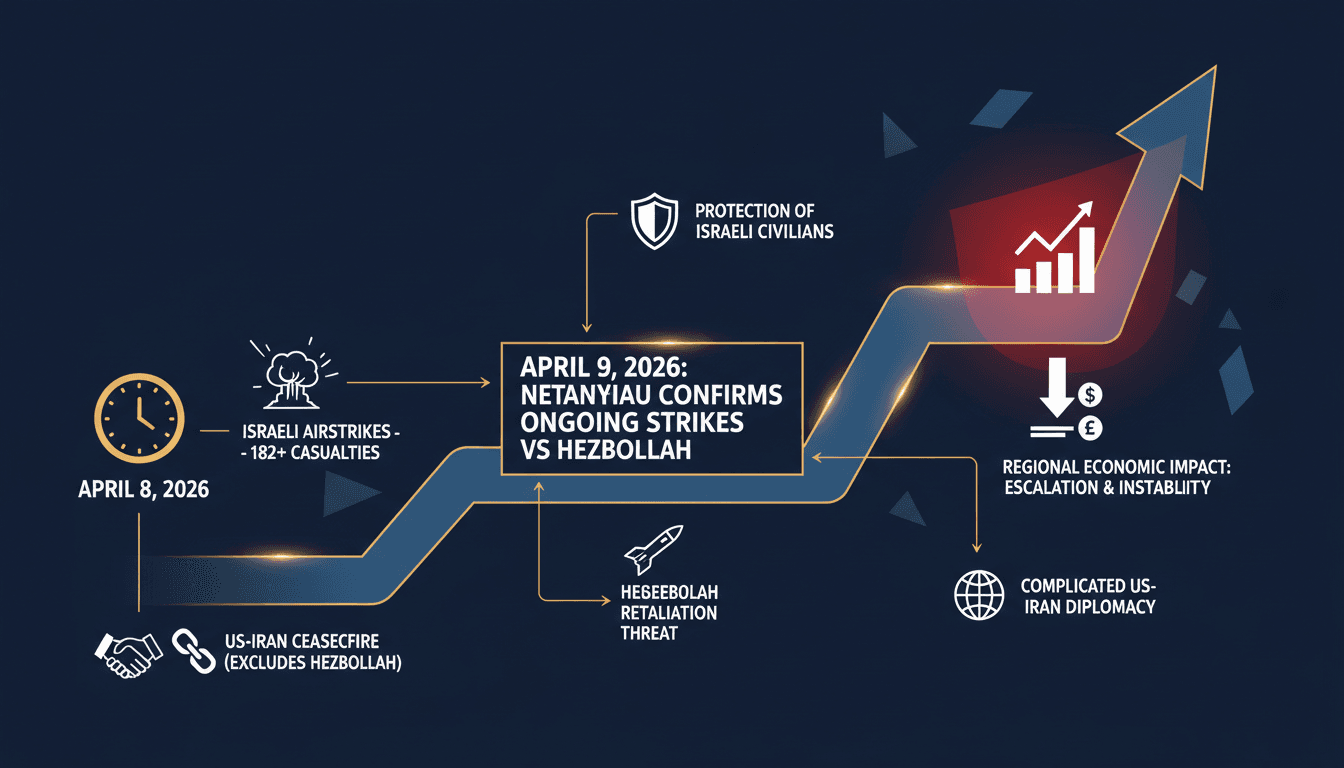
Here's what it means for you.
If you’re involved in international business or travel, escalating tensions in the Middle East could impact your operations and safety.
Why it matters
The ongoing conflict between Israel and Hezbollah threatens to destabilize the region, affecting global markets and security.
What happened (in 30 seconds)
- Netanyahu declared continued Israeli strikes on Hezbollah, emphasizing a commitment to protect Israeli civilians.
- Massive airstrikes on April 8 resulted in at least 182 deaths in southern Lebanon, marking a significant escalation in the conflict.
- The US-Iran ceasefire is in effect, but Netanyahu clarified it does not apply to Hezbollah, potentially complicating diplomatic efforts.
The context you actually need
- The conflict escalated on March 2, 2026, when Israel began airstrikes in response to Hezbollah rocket attacks, setting the stage for ongoing military operations.
- The April 8 strikes were the largest Israeli military action against Hezbollah infrastructure, indicating a shift in Israel's military strategy.
- UAE officials are seeking clarity on the US-Iran ceasefire's applicability to the Israel-Hezbollah situation, highlighting regional concerns over spillover effects.
What's really happening
On April 9, 2026, Israeli Prime Minister Benjamin Netanyahu reaffirmed Israel's aggressive military stance against Hezbollah, stating that the country would continue to strike with "force, precision, and determination." This declaration follows a series of extensive airstrikes on April 8, which resulted in significant casualties, including at least 182 deaths, as reported by the Lebanese Health Ministry. The airstrikes targeted key Hezbollah positions in southern Lebanon, particularly in Tyre and Abbasiyeh, marking the largest military operation against the group to date.
The backdrop of this conflict is a broader confrontation between the US and Iran, which has recently seen a ceasefire agreement. However, Netanyahu's statement makes it clear that Israel does not consider Hezbollah's actions as part of this truce. This distinction is crucial as it indicates Israel's intent to maintain military pressure on Hezbollah, regardless of the diplomatic landscape. The Israeli government perceives Hezbollah as a direct threat to its national security, particularly in light of the group's history of rocket attacks and military engagements against Israel.
The ongoing strikes against Hezbollah are not just a military response; they reflect Israel's strategic calculus in a volatile region. By continuing its operations, Israel aims to deter future attacks and demonstrate its military capabilities. This approach, however, risks further escalation, as Hezbollah is likely to retaliate, potentially leading to a broader conflict that could involve other regional players.
The implications of this conflict extend beyond immediate military concerns. The violence has already resulted in over 890 reported injuries from the April 8 attacks alone, creating a humanitarian crisis in Lebanon. Furthermore, the regional instability could have economic repercussions, particularly for countries like the UAE, which are closely monitoring the situation due to its potential impact on oil prices and international trade routes.
As the situation evolves, the interplay between military actions and diplomatic efforts will be critical in determining the future of the region. The ongoing violence could undermine any progress made in US-Iran relations, complicating efforts to stabilize the Middle East.
Who feels it first (and how)
- International travelers: Increased risks of flight disruptions and safety concerns in the region.
- Businesses in the Middle East: Potential supply chain disruptions and market volatility due to heightened tensions.
- Local populations in Lebanon and Israel: Direct impact from military actions, leading to casualties and humanitarian crises.
What to watch next
- Continued military operations: Monitor the frequency and scale of Israeli strikes on Hezbollah, as this will indicate the potential for further escalation.
- US diplomatic efforts: Watch for any shifts in US policy regarding the ceasefire and its implications for Israel-Hezbollah relations.
- Regional economic indicators: Keep an eye on oil prices and market reactions in the UAE and surrounding areas, as instability could lead to fluctuations.
Israel's military operations against Hezbollah are ongoing and intensifying.
The conflict will escalate further, with potential for increased regional involvement.
The long-term effects of the US-Iran ceasefire on the Israel-Hezbollah dynamic remain uncertain.
Insights by A47 Intelligence
Arabic-language UAE newspaper coverage focused on domestic affairs, public institutions, business, society, and regional developments.
"Al Khaleej coverage generally reflects a mainstream UAE editorial lens with strong attention to public affairs, institutions, and regional developments."
— A47 Editor
نتنياهو: سنواصل ضرب حزب الله بقوة
Israeli Prime Minister Benjamin Netanyahu emphasized on Thursday that Israel will continue to strike Hezbollah 'wherever necessary,' following extensive airstrikes on Lebanon that resulted in over two hundred fatalities.
Regional and international reporting focused on Middle Eastern politics, diplomacy, and economics.
"Asharq Al-Awsat is a Saudi-owned international newspaper reflecting mainstream Gulf political perspectives."
— A47 Editor
Israel Says Will Continue to Strike Hezbollah 'Wherever Necessary'
Israel has announced its intention to continue military strikes against Hezbollah wherever deemed necessary, following a series of airstrikes that have escalated tensions in the region. The Israeli military has specifically targeted Hezbollah positio...