
Germany's February 2026 Economic Data Shows Mixed Signals with Export Growth and Production Decline
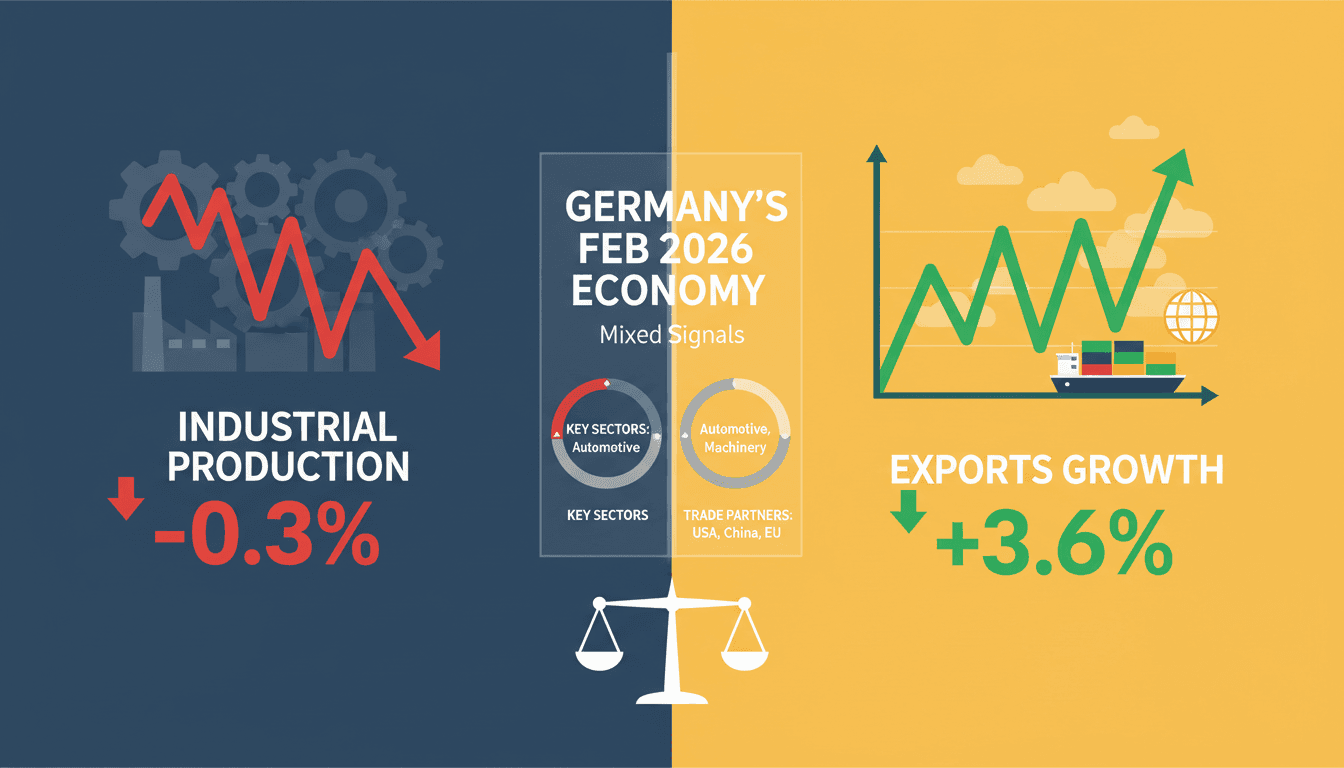
Here's what it means for you.
If you're involved in international trade or manufacturing, Germany's mixed economic signals could impact your supply chains and market strategies.
Why it matters
Germany's economic performance is a bellwether for the EU, influencing trade policies and economic forecasts across the continent.
What happened (in 30 seconds)
- Industrial production fell 0.3% month-on-month in February 2026, contrary to expectations of 0.7% growth.
- Exports surged 3.6% month-on-month, driven by strong demand from EU partners, despite a 7.5% drop in exports to the U.S. due to tariffs.
- Imports increased by 4.7%, narrowing the trade surplus to 19.8 billion euros, down from 20.3 billion in January.
The context you actually need
- Germany's economy has faced challenges, including two recessions in 2023 and 2024, and a modest recovery of 0.2% GDP growth in 2025.
- High energy costs and anticipated U.S. tariffs have contributed to volatility in industrial production and low capacity utilization.
- Exports have benefited from front-loading strategies as companies anticipate trade barriers, indicating a shift in how businesses prepare for international trade.
What's really happening
Germany's February 2026 economic data reveals a complex interplay of external and internal factors affecting its economy. The 0.3% decline in industrial production, which was unexpected, highlights persistent weaknesses in domestic manufacturing. This decline is attributed to several structural challenges, including high energy costs stemming from the post-Russia-Ukraine conflict and a slowdown in demand from key trading partners like China. The anticipated U.S. tariffs have further complicated matters, leading to a significant 7.5% drop in exports to the U.S., a critical market for German goods.
Conversely, the 3.6% surge in exports indicates robust external demand, particularly from EU partners, where exports grew by 5.8%. This divergence suggests that while domestic production struggles, Germany's position as a key exporter remains strong, driven by competitive sectors such as machinery, vehicles, and pharmaceuticals. The increase in imports by 4.7% also reflects a growing demand for foreign goods, which narrows the trade surplus to 19.8 billion euros.
The Bundesbank's forecasts indicate a gradual recovery in 2026, but this is tempered by global trade slowdowns and ongoing pressures from U.S. tariffs. Economists view the mixed signals as a setback for hopes of a robust industrial recovery, emphasizing that low capacity utilization continues to hinder investment in the manufacturing sector. The market's reaction included minor fluctuations in the euro, with a focus on the European Central Bank's policy decisions, which could further influence economic conditions in the eurozone.
As businesses navigate these challenges, the emphasis on front-loading exports suggests a strategic shift in how companies prepare for potential trade barriers. This adaptability may help mitigate some risks associated with domestic production weaknesses, but the overall economic landscape remains uncertain.
Who feels it first (and how)
- Manufacturers: Facing pressure from high energy costs and reduced domestic production.
- Exporters: Benefiting from strong demand in the EU but struggling with U.S. tariffs.
- Importers: Experiencing increased costs due to rising import levels and potential supply chain disruptions.
- Economists and Analysts: Monitoring shifts in economic indicators for insights into future trends.
What to watch next
- U.S. tariff policies: Changes could significantly impact export levels and trade dynamics.
- Bundesbank forecasts: Updates on economic growth projections will influence market confidence.
- Capacity utilization rates: Improvements could signal a rebound in domestic production and investment.
Industrial production is currently declining, and exports are rising.
Continued volatility in trade due to external pressures, particularly from U.S. tariffs.
The long-term impact of these mixed signals on Germany's overall economic recovery.
This article was generated by AI from 2 verified sources and reviewed by A47 editorial systems.
Pan-Arab news coverage spanning politics, business, sports, and regional affairs.
"Asharq Al-Awsat reflects a broad Arab editorial perspective with strong attention to regional geopolitics."
— A47 Editor
أداء متناقض لأكبر اقتصاد أوروبي... نمو الصادرات يقابله تراجع الإنتاج
Germany's industrial production unexpectedly declined in February, while exports performed stronger than anticipated, indicating a divergence in the indicators of the largest European economy.
Macro commentary, policy analysis, growth/inflation themes, and global outlooks.
"Contextual macro coverage that complements day-to-day market headlines."
— A47 Editor
German exports rise more than expected in February
German exports rose more than expected in February, signaling a positive shift in the country's trade performance amid ongoing economic challenges. This increase comes after a period of decline at the start of 2026, where exports had been negatively ...