
U.S. Navy Intercepts Iranian Oil Tanker Dorena Amid Blockade Enforcement
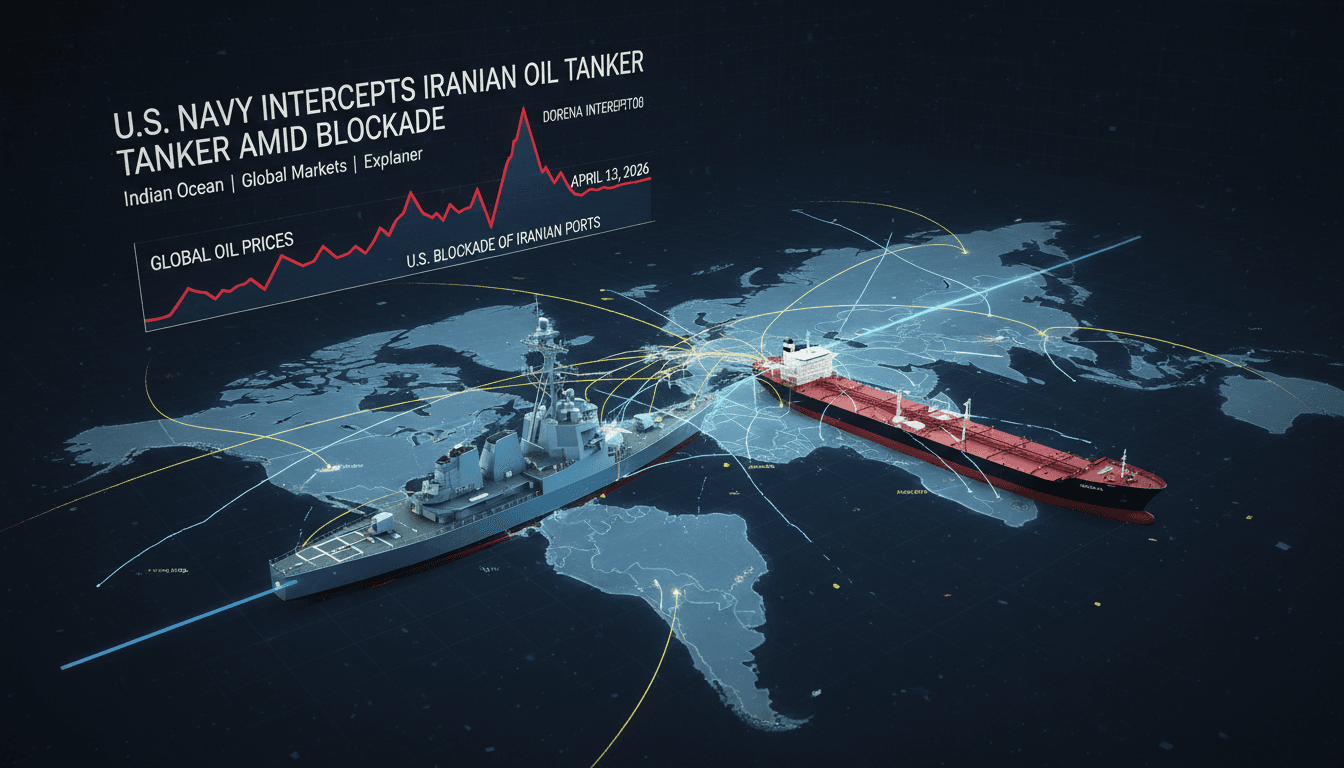
Here's what it means for you.
Rising oil prices and potential supply chain disruptions could impact your daily expenses and business operations.
Why it matters
The U.S. Navy's interception of the Dorena signals a significant escalation in maritime enforcement against Iran, affecting global oil markets and regional stability.
What happened (in 30 seconds)
- U.S. destroyer intercepted the Iranian-flagged oil tanker Dorena after it evaded a naval blockade in the Indian Ocean.
- Blockade initiated on April 13, 2026, aims to disrupt Iran's oil exports amid ongoing regional conflict and sanctions evasion.
- Oil prices surged by 8% to $104 per barrel following the incident, impacting consumers and businesses globally.
The context you actually need
- U.S. blockade: The blockade was established after peace talks collapsed, targeting Iran's 'ghost fleet' of vessels that evade sanctions.
- Tactics employed: Ships like the Dorena disable their transponders to avoid detection, complicating enforcement efforts.
- Regional implications: The Strait of Hormuz is a critical chokepoint for global oil shipments, making any disruption a concern for international markets.
What's really happening
The U.S. Navy's interception of the Dorena is part of a broader strategy to enforce sanctions against Iran, particularly its oil exports. The blockade, initiated on April 13, 2026, was a response to the collapse of peace negotiations in Islamabad, which aimed to resolve the ongoing conflict involving U.S. and Israeli forces. By targeting Iran's 'ghost fleet'—a network of vessels that evade sanctions through tactics like disabling their Automatic Identification System (AIS)—the U.S. seeks to pressure Tehran into accepting terms for a ceasefire proposed by President Trump.
The Dorena's attempt to slip past the U.S. naval cordon highlights the challenges of enforcing maritime law in open waters. The vessel, likely loaded with oil from Chabahar, deactivated its AIS to avoid detection as it navigated into the Indian Ocean. This incident exemplifies the lengths to which Iran will go to maintain its oil exports, which are crucial for its economy, especially amid heightened sanctions.
The U.S. Central Command reported that since the blockade began, 29 vessels have been directed to turn around or return to Iranian ports. This aggressive enforcement strategy is designed to disrupt Iran's oil revenue, which is vital for funding its military and regional activities. The ongoing naval operations are likely to escalate tensions in the region, with Iran warning of retaliation against U.S. forces.
As a result of these developments, oil markets have experienced volatility, with prices spiking due to fears of supply disruptions. The UAE, a key player in the region, is closely monitoring traffic in the Strait of Hormuz, where a significant portion of the world's oil passes. The situation remains fluid, with potential implications for global energy prices and regional security.
Who feels it first (and how)
- Consumers: Higher fuel prices directly impact transportation and heating costs.
- Businesses: Companies reliant on oil and shipping may face increased operational costs and delays.
- Investors: Volatility in oil markets can affect stock prices and investment strategies.
- Regional governments: Countries near the Strait of Hormuz may experience economic pressures and security concerns.
What to watch next
- Oil price fluctuations: Continued enforcement actions could lead to further price increases, affecting global markets.
- Iran's response: Watch for potential retaliatory actions from Iran, which could escalate military tensions in the region.
- Shipping disruptions: Increased naval activity may lead to delays in shipping routes, impacting global supply chains.
The U.S. Navy will continue to enforce the blockade and intercept vessels attempting to evade it.
Oil prices will remain volatile as tensions escalate and enforcement actions continue.
The long-term impact on U.S.-Iran relations and the potential for diplomatic resolutions remains uncertain.
Insights by A47 Intelligence
Global political, business, and cultural coverage from WSJ international desks.
"The Wall Street Journal offers extensive international reporting with a reputation for financial insight and a center-right editorial stance."
— A47 Editor
An Iranian Ship Tried to Slip the Blockade. A U.S. Destroyer Chased It Down.
An Iranian ship attempted to breach a U.S. naval blockade in the Strait of Hormuz, prompting a U.S. destroyer to pursue and intercept it. This incident highlights the ongoing tensions between the U.S. and Iran, particularly regarding Iran's oil trade...
Capitol Hill news, legislation, and policy insight.
"The Hill specializes in U.S. politics and policy, with a focus on Capitol Hill developments and a reputation for insider reporting."
— A47 Editor
US military intercepts another Iranian ship
The U.S. military has intercepted an Iranian oil tanker in the Indian Ocean, part of a naval blockade authorized by President Trump. This operation is aimed at enforcing restrictions on Iranian maritime activities amid rising tensions between the U.S...
Market-moving headlines impacting equities, bonds, and related risk assets.
"Real-time catalysts and volatility drivers across indices and sectors."
— A47 Editor
Ship attacks, seizures boost U.S.-Iran tensions; mediators try for more talks
Recent maritime confrontations have escalated tensions between the U.S. and Iran, highlighted by the seizure of multiple ships by Iranian forces and U.S. Navy interceptions of Iranian tankers. These incidents reflect ongoing disputes over shipping ro...
Conservative-leaning political and national coverage.
"The Washington Times is a conservative-leaning newspaper known for its political coverage and advocacy of right-of-center viewpoints."
— A47 Editor
U.S. military says it seized another oil tanker associated with Iran
The U.S. military has seized another oil tanker linked to Iranian oil smuggling, escalating tensions with Iran following the Revolutionary Guards' recent seizure of two vessels in the Strait of Hormuz. This action underscores the ongoing maritime sta...
Pan-Arab news coverage spanning politics, business, sports, and regional affairs.
"Asharq Al-Awsat reflects a broad Arab editorial perspective with strong attention to regional geopolitics."
— A47 Editor
الجيش الأميركي يقول إنه سيطر على ناقلة نفط أخرى مرتبطة بإيران
The U.S. military announced on Thursday that it has seized another oil tanker linked to Iranian oil smuggling activities. This operation highlights ongoing tensions related to Iran's oil exports and the enforcement of sanctions aimed at curbing its o...
International news coverage curated for readers in the UAE and Gulf region.
"Emirates 24|7 world coverage presents global developments through a UAE-facing and Gulf-relevant editorial lens."
— A47 Editor
US intercepts 3 Iranian oil tankers in Asian waters, sources say US intercepts 3 Iranian oil tankers in Asian waters, sources say
The US military has intercepted three Iranian-flagged oil tankers in Asian waters, redirecting them away from locations near India, Malaysia, and Sri Lanka, amid ongoing tensions between the US and Iran. This action follows a blockade imposed by Wash...
Conservative-leaning political and national coverage.
"The Washington Times is a conservative-leaning newspaper known for its political coverage and advocacy of right-of-center viewpoints."
— A47 Editor
U.S. forces board sanctioned tanker in Indo-Pacific carrying Iranian oil, Pentagon says
The U.S. military intercepted and boarded a sanctioned cargo vessel carrying Iranian oil in the Indo-Pacific region, as confirmed by the Pentagon. This operation highlights ongoing enforcement actions against vessels violating U.S. sanctions.