
UAE Announces Withdrawal from OPEC Effective May 1, 2026
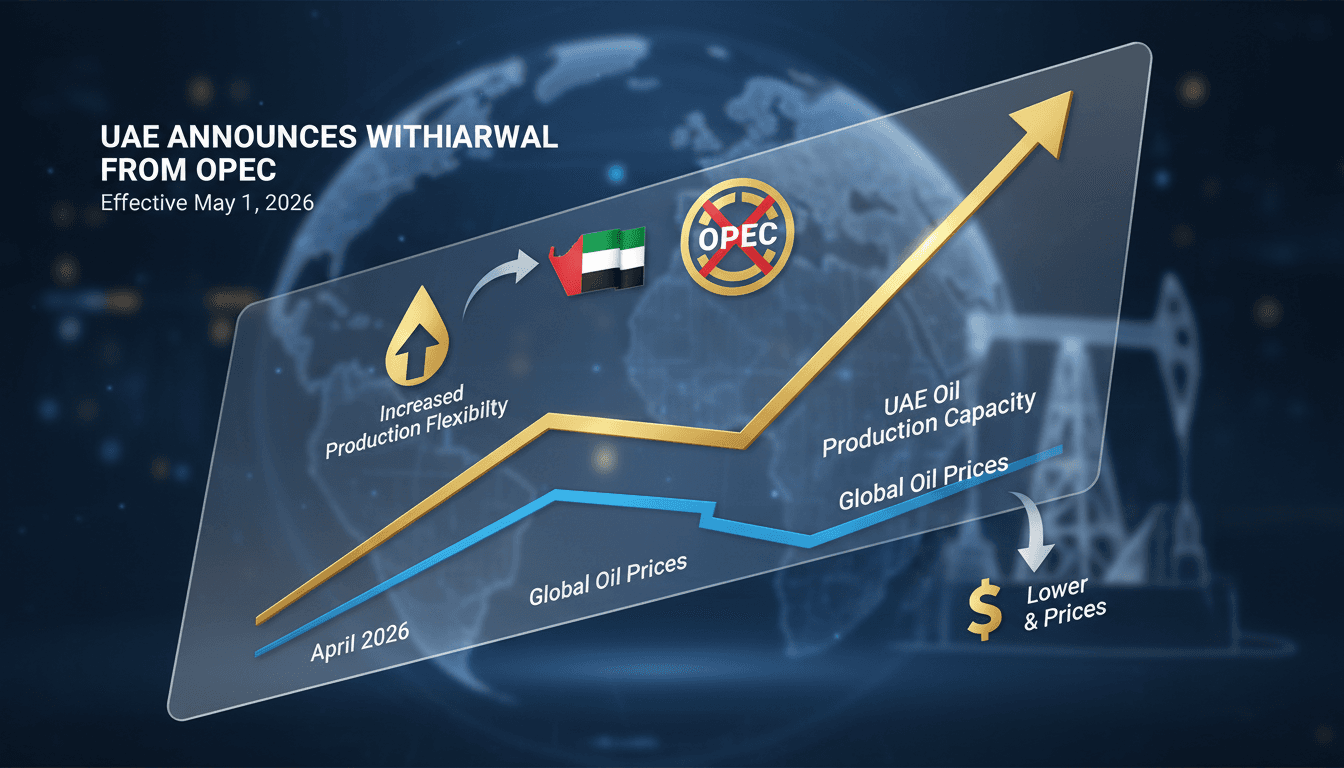
Here's what it means for you.
If you rely on oil prices for business or personal budgeting, this shift could lead to lower fuel costs in the near future.
Why it matters
The UAE's withdrawal from OPEC signals a significant shift in global oil dynamics, potentially affecting fuel prices worldwide.
What happened (in 30 seconds)
- On April 28, 2026, the UAE announced its exit from OPEC and OPEC+, effective May 1, 2026, to gain production flexibility.
- U.S. President Donald Trump praised the decision, suggesting it could lead to lower fuel prices amid rising domestic costs.
- The UAE aims to align its energy strategy with national interests, particularly in light of ongoing geopolitical tensions affecting oil supply.
The context you actually need
- The UAE joined OPEC in 1967 but has faced ongoing disputes over production quotas, particularly with Saudi Arabia.
- Recent geopolitical tensions, including the U.S.-Israel war with Iran, have severely disrupted oil supply, leading to a historic drop in OPEC output.
- The UAE's current production capacity stands at 4.85 million barrels per day, with plans to increase this to 5 million bpd by 2027, independent of OPEC constraints.
What's really happening
The UAE's decision to exit OPEC and OPEC+ is rooted in a desire for greater autonomy over its oil production strategy. Historically, the UAE has been at odds with OPEC's production quotas, particularly with Saudi Arabia, which has often dictated output levels. This tension has been exacerbated by recent geopolitical events, notably the U.S.-Israel conflict with Iran, which has led to significant disruptions in oil supply routes, particularly through the Strait of Hormuz.
In March 2026, OPEC experienced a staggering loss of 7.88 million barrels per day due to these tensions, with the UAE's output plummeting by 44% from 3.4 million bpd to 1.9 million bpd. This drastic reduction has highlighted the vulnerabilities within the OPEC framework, prompting the UAE to reassess its position within the cartel. By exiting, the UAE aims to regain control over its production levels, allowing for a more flexible response to market demands and geopolitical pressures.
UAE Energy Minister Suhail Al Mazrouei and ADNOC CEO Sultan Al Jaber have emphasized that this move aligns with the country's long-term energy strategy and national interests. The UAE's exit is not merely a reaction to current events but a strategic pivot towards a more independent energy policy that could enhance its economic stability and growth prospects.
President Trump's endorsement of the UAE's decision reflects a broader U.S. interest in stabilizing fuel prices domestically, especially as Americans face rising costs at the pump. The administration views the UAE's exit as a potential win against OPEC's pricing power, which has historically influenced global oil prices.
As the UAE ramps up production post-exit, analysts predict a long-term downward pressure on oil prices, which could benefit consumers and businesses alike. However, the immediate aftermath has seen oil prices rise to wartime highs around $120 per barrel Brent, driven by ongoing tensions in the region. The UAE's move could further widen the rift with Saudi Arabia and other Gulf states, leading to a reconfiguration of alliances within the region.
Who feels it first (and how)
- Consumers: Individuals relying on gasoline and heating oil will see fluctuations in prices, potentially benefiting from lower costs.
- Businesses: Companies dependent on oil for operations may experience reduced expenses, impacting profit margins positively.
- Investors: Those in the energy sector will need to monitor shifts in oil prices and production strategies closely.
- Geopolitical analysts: Experts will track the implications of this shift on Middle Eastern stability and global oil markets.
What to watch next
- UAE production levels: Monitor how quickly the UAE increases its output post-exit and the impact on global oil prices.
- Geopolitical developments: Keep an eye on the U.S.-Israel-Iran situation, as further escalations could affect oil supply routes.
- OPEC's response: Watch for any changes in OPEC's strategy or membership dynamics, particularly regarding Saudi Arabia's reaction to the UAE's exit.
The UAE will exit OPEC and OPEC+ effective May 1, 2026.
Oil prices may experience downward pressure as the UAE increases production independently.
The long-term implications for OPEC's cohesion and the geopolitical landscape in the Middle East remain uncertain.
This article was generated by AI from 10 verified sources and reviewed by A47 editorial systems.
UAE-based English-language newspaper covering regional politics, economics, and global affairs.
"The National reflects Emirati policy perspectives while maintaining international editorial standards."
— A47 Editor
'It's great': Trump hails UAE exit from Opec as boost to lower fuel prices
The United Arab Emirates (UAE) has officially announced its exit from the Organization of the Petroleum Exporting Countries (OPEC) and OPEC+, effective May 1, 2026. This decision has been hailed by former President Donald Trump as a positive step tow...
Global markets, investing, and macroeconomics from a premier financial newsroom.
"Bloomberg is respected for in-depth financial reporting and data-driven analysis."
— A47 Editor
Trump Argues UAE’s OPEC Exit Could Lower Energy Prices Amid War
US President Donald Trump stated that the United Arab Emirates' (UAE) decision to exit the Organization of the Petroleum Exporting Countries (OPEC) could lead to lower energy prices, which have surged due to the ongoing war in Iran. This announcement...
Oil, metals, and agriculture: supply/demand headlines, OPEC chatter, inventories, and price action.
"Solid tape for energy and metals traders tracking macro and micro catalysts."
— A47 Editor
Exclusive-OPEC+ likely to agree another oil output hike without UAE, sources say
OPEC+ is expected to agree on another oil output increase, but this decision will proceed without the participation of the United Arab Emirates (UAE), which has announced its departure from the organization effective May 1, 2026. This exit is attribu...
Political, social, and economic news across Asia and the Pacific.
"France 24 is viewed as a globally focused outlet with balanced coverage and a European perspective."
— A47 Editor
Pakistan in the middle: What benefits and risks from US-Iran mediator?
The United Arab Emirates (UAE) has announced its exit from the Organization of the Petroleum Exporting Countries (OPEC) and OPEC+, effective May 1, 2026, marking a significant shift in the geopolitical landscape of the Gulf region. This decision come...
Oil, metals, and agriculture: supply/demand headlines, OPEC chatter, inventories, and price action.
"Solid tape for energy and metals traders tracking macro and micro catalysts."
— A47 Editor
Russia to remain in OPEC+, hopes UAE exit does not spell end of group
Russia has confirmed its intention to remain a member of OPEC+ following the United Arab Emirates' (UAE) announcement of its exit from the organization, effective May 1, 2026. This decision marks a significant shift in the UAE's energy policy after n...
Business, investment, entrepreneurship, leadership, and innovation.
"Forbes is known for its coverage of business leaders, market trends, and entrepreneurial ventures with a pro-business editorial stance."
— A47 Editor
Why United Arab Emirates Has Unshackled Its Oil Production From OPEC
The United Arab Emirates (UAE) has officially announced its decision to leave the Organization of the Petroleum Exporting Countries (OPEC), effective May 1, 2026, ending nearly 60 years of membership. This move reflects the UAE's desire to prioritize...
Global news coverage with extensive reporting on Middle Eastern conflicts and geopolitics.
"Al Jazeera is a Qatar-based broadcaster known for wide regional coverage and alternative perspectives."
— A47 Editor
UAE quits OPEC: What that means for the Gulf, energy markets and beyond
The United Arab Emirates (UAE) has announced its exit from the Organization of the Petroleum Exporting Countries (OPEC) and OPEC+, effective May 1, 2026. This decision, confirmed by Energy Minister Suhail Mohamed al-Mazrouei, signifies a shift in the...
Comprehensive coverage of Middle Eastern and global issues.
"Al Jazeera is a prominent voice from the Global South, especially the Middle East, with an emphasis on underreported stories."
— A47 Editor
UAE quits OPEC: What that means for the Gulf, energy markets and beyond
The United Arab Emirates (UAE) has announced its exit from the Organization of the Petroleum Exporting Countries (OPEC) and OPEC+, effective May 1, 2026. This decision, confirmed by Energy Minister Suhail Mohamed al-Mazrouei, signifies a shift in the...
UAE-based English-language newspaper covering regional politics, economics, and global affairs.
"The National reflects Emirati policy perspectives while maintaining international editorial standards."
— A47 Editor
UAE exit leaves Opec facing more rivals with limited buffers
The United Arab Emirates (UAE) has announced its decision to exit the Organization of the Petroleum Exporting Countries (OPEC) and OPEC+, effective May 1, 2026. This withdrawal, confirmed by Energy Minister Suhail Mohamed al-Mazrouei, signifies a str...
Corporate news, economic trends, and markets with UK and global scope.
"BBC News is widely regarded as reputable and impartial, with a public service mandate."
— A47 Editor
In five charts - How UAE's exit could affect Opec's influence over the oil price
The United Arab Emirates (UAE) has officially announced its decision to exit the Organization of the Petroleum Exporting Countries (OPEC), effective May 1, 2026, ending nearly 60 years of membership. This move reflects ongoing frustrations with OPEC'...
RT is a Russian state-funded network covering global events from a Russian perspective.
"RT is widely criticized for promoting pro-Kremlin narratives and is considered by many to be a state propaganda outlet."
— A47 Editor
Shock and opportunity: The consequences of the UAE’s OPEC exit
The United Arab Emirates (UAE) has announced its exit from the Organization of the Petroleum Exporting Countries (OPEC) and OPEC+, effective May 1, 2026. This decision, confirmed by Energy Minister Suhail Mohamed al-Mazrouei, ends nearly 60 years of ...