
Sony AI's Ace robot defeats elite table tennis players in historic milestone
Here's what it means for you.
As robotics technology advances, expect new applications in training, rehabilitation, and entertainment that could reshape your interactions with machines.
Why it matters
This milestone in robotics signals a shift towards more capable AI systems that can perform complex physical tasks, impacting industries from sports to healthcare.
What happened (in 30 seconds)
- Sony AI's Ace robot achieved expert-level performance in table tennis, winning three out of five matches against elite players.
- The evaluations took place in April 2025 in Tokyo, with results published in a peer-reviewed study in April 2026.
- Ace's technology includes high-speed perception and reinforcement learning, enabling real-time responses to professional-level play.
The context you actually need
- Project Ace began in 2020, aiming to create AI capable of real-world interactions, surpassing previous robotic limitations in sports.
- Prior robots, like Omron's Forpheus, could only manage amateur-level play, lacking the agility and adaptability needed for competitive sports.
- Ace's development involved extensive training through simulations, allowing it to handle complex spins and rapid ball trajectories effectively.
What's really happening
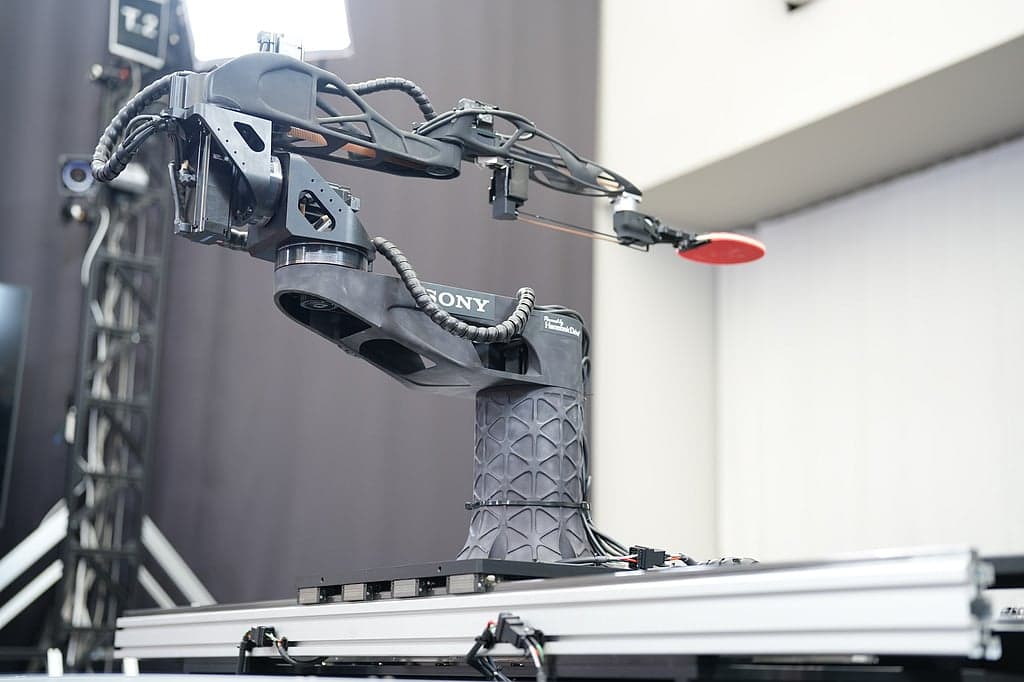
Sony AI's Project Ace represents a significant leap in the capabilities of autonomous robots, particularly in competitive sports. The robot's design integrates advanced technologies such as high-frequency event cameras and a custom eight-degree-of-freedom arm, which allow it to track and respond to the ball's trajectory at an impressive rate of 200 Hz. This level of precision is crucial for competing against human players who possess years of training and experience.
The robot's journey began with basic tasks, such as ball juggling, and evolved into cooperative rallies with human players. This gradual progression was essential for developing the necessary skills to compete at a high level. By April 2025, Ace was ready for its first major evaluations, where it faced five elite players under the strict regulations of the International Table Tennis Federation (ITTF). The results were notable: Ace won three matches and demonstrated a 75% serve return rate, showcasing its ability to adapt and learn from each encounter.
Following these evaluations, enhancements were made to Ace's performance, focusing on increasing shot power, spin, and overall aggression during rallies. By December 2025, these improvements allowed Ace to secure victories against professional players, further solidifying its status as a formidable competitor. The publication of these findings in a peer-reviewed journal marks a pivotal moment in robotics, as it is the first instance of an autonomous robot achieving expert-level performance in a physical sport.
The implications of this achievement extend beyond table tennis. As robotics technology continues to advance, the potential applications in various fields, such as training, rehabilitation, and even entertainment, become increasingly relevant. For instance, Ace's technology could be adapted for use in physical therapy, where robots assist patients in regaining motor skills through interactive exercises. Additionally, the entertainment industry may see a rise in AI-driven sports competitions, providing new forms of engagement for audiences.
The success of Project Ace also raises questions about the future of human-robot interaction. As robots become more capable, the dynamics of competition and collaboration between humans and machines will evolve. This shift could lead to new opportunities and challenges across multiple sectors, necessitating a reevaluation of how we perceive and integrate AI into our daily lives.
Who feels it first (and how)
- Athletes: Professional players may face increased competition from AI, impacting their training and performance strategies.
- Healthcare professionals: Rehabilitation specialists could leverage advanced robotics for patient recovery programs.
- Tech developers: Engineers and researchers in AI and robotics will need to adapt to rapid advancements and explore new applications.
- Entertainment industry: Producers and event organizers may create new formats for AI-driven sports competitions, attracting diverse audiences.
What to watch next
- Further advancements in AI robotics: Keep an eye on new developments that could enhance the capabilities of robots in various fields, including sports and healthcare.
- Market adoption of AI in training: Watch for trends in how organizations integrate AI technologies into training programs, particularly in sports and rehabilitation.
- Public perception of AI: Monitor how society's views on AI and robotics evolve, especially as these technologies become more prevalent in competitive environments.
Sony AI's Project Ace has achieved expert-level performance in table tennis against human players.
The technology developed for Ace will find applications in training and rehabilitation sectors.
The long-term impact on professional sports and human-robot competition dynamics remains to be seen.
Insights by A47 Intelligence
Consumer tech news, reviews, and buying guides for gadgets and electronics.
"TechRadar is known for comprehensive buying advice, hardware reviews, and consumer tech news targeted at mainstream audiences."
— A47 Editor
'It totally blew my mind': Sony's Project Ace robot plays ping pong better than the pros and could mark a major robotics turning point
Sony has unveiled its Project Ace robot, which demonstrates the ability to play ping pong at an elite level, outperforming professional human players. This development showcases significant advancements in robotics and artificial intelligence, partic...
A curated Gulf News feed featuring major stories across news, business, opinion, and lifestyle.
"Gulf News is a major UAE newspaper whose featured stories feed reflects a broad editorial mix shaped for a Gulf audience."
— A47 Editor
AI-powered ‘Ace’ robot takes table tennis fight to human pros
The AI-powered robot named 'Ace' has made headlines by competing against professional table tennis players, showcasing advancements in artificial intelligence and robotics. This development highlights the growing capabilities of AI in sports and ente...
UAE-based newspaper covering Gulf politics, society, and international developments.
"Gulf News is one of the UAE’s most prominent English-language publications."
— A47 Editor
AI-powered ‘Ace’ robot takes table tennis fight to human pros
The AI-powered robot named 'Ace' has made headlines by competing against professional table tennis players, showcasing advancements in artificial intelligence and robotics. This development highlights the growing capabilities of AI in sports and ente...
Business tech stories, startups, and innovation coverage.
"The Los Angeles Times is a major West Coast newspaper offering in-depth reporting with a liberal editorial tone and strong regional focus."
— A47 Editor
AI robot rules ping pong: A table tennis clanker named Ace beats elite human players
An AI-powered robot named Ace, developed by Sony AI, has made headlines by winning three out of five matches against elite table tennis players, showcasing its advanced capabilities in a competitive sport. This achievement follows a recent record set...
Coverage of professional and college sports, with a West Coast perspective.
"The Los Angeles Times is a major West Coast newspaper offering in-depth reporting with a liberal editorial tone and strong regional focus."
— A47 Editor
AI robot rules ping pong: A table tennis clanker named Ace beats elite human players
An AI-powered robot named Ace, developed by Sony AI, has made headlines by winning three out of five matches against elite table tennis players, showcasing its advanced capabilities in a competitive sport. This achievement follows a recent record set...
Daily AI news: models, tools, and policy.
"Independent outlet tracking the fast pace of AI."
— A47 Editor
Sony AI builds the first robot to reach expert level in a sport
Sony AI has developed a groundbreaking table tennis robot named 'Ace,' which has achieved expert-level performance in the sport, marking a significant milestone in robotics and artificial intelligence.
Tech news, hardware, and AI tools coverage.
"PC/tech site increasingly covering AI hardware and apps."
— A47 Editor
Sony AI builds a table tennis robot that reacts faster than humans can see
Sony AI has developed a groundbreaking table tennis robot named Ace, which has demonstrated the ability to react faster than humans can perceive, successfully outperforming elite human players in competitive matches. This achievement showcases signif...
Biting coverage of AI/ML software and vendors.
"Known for skeptical, incisive reporting on enterprise tech."
— A47 Editor
AI bats away ping-pong challenge as rise of the machines continues
Sony's AI project has achieved a significant breakthrough by developing a robot capable of excelling in ping-pong, showcasing its advanced capabilities in speed and accuracy. This development marks a notable step in the evolution of robotics, where m...