
US Existing-Home Sales Drop 3.6% in March 2026
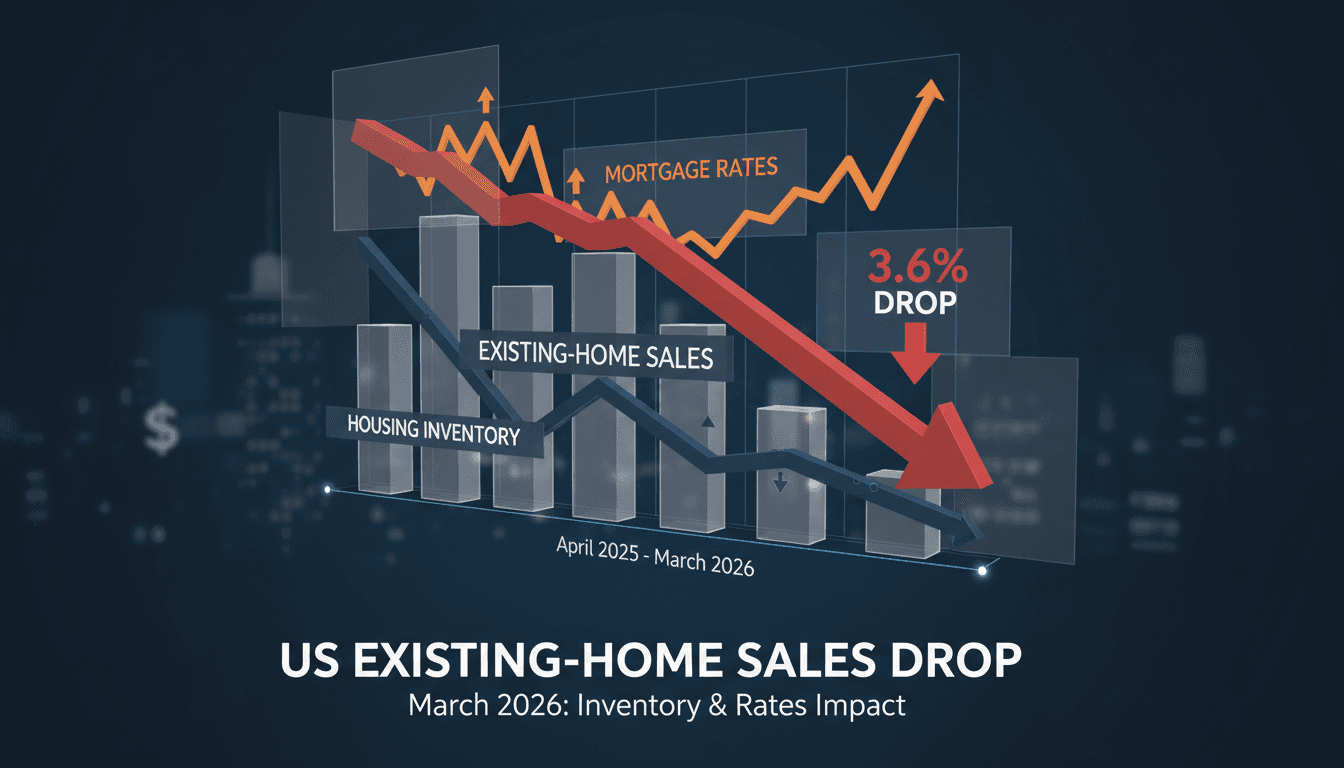
Here's what it means for you.
If you're considering buying or selling a home, the current market dynamics could significantly impact your strategy and financial outcomes.
Why it matters
The decline in existing-home sales signals ongoing challenges in the U.S. housing market, affecting consumer confidence and economic stability.
What happened (in 30 seconds)
- Existing-home sales in the U.S. fell 3.6% in March 2026 to a seasonally adjusted annual rate of 3.98 million units, marking the lowest level since June 2025.
- Inventory levels increased by 3.0% to 1.36 million units, equating to 4.1 months of supply, yet remain below historical norms.
- Median sales price rose 1.4% year-over-year to $408,800, indicating persistent demand despite declining sales.
The context you actually need
- High mortgage rates: Average mortgage rates have climbed to 6.18%, influenced by Federal Reserve actions to combat inflation, discouraging new buyers.
- Lock-in effect: Homeowners with low, pandemic-era mortgage rates are hesitant to sell, contributing to tight inventory and limiting new listings.
- Geopolitical tensions: Ongoing global conflicts, particularly in the Middle East, have exacerbated economic uncertainty, further influencing mortgage rates and consumer confidence.
What's really happening
The U.S. housing market is experiencing a significant slowdown, with existing-home sales declining by 3.6% in March 2026, reflecting a broader trend of subdued activity that has persisted since 2022. This downturn is largely attributed to the combination of elevated mortgage rates and a persistent "lock-in effect" among homeowners. Many current homeowners secured mortgages at rates below 4% during the pandemic and are reluctant to list their properties, fearing they will not find comparable financing in the current environment.
The National Association of Realtors (NAR) has noted that the current inventory of homes for sale remains below historical norms, which is contributing to the sluggish sales figures. The increase in inventory by 3.0% to 1.36 million units is a small relief but still equates to only 4.1 months of supply, indicating that the market is not yet balanced. The median sales price has risen to $408,800, up 1.4% year-over-year, suggesting that while sales are declining, demand for homes remains, albeit constrained by affordability issues.
The economic backdrop is further complicated by geopolitical tensions, particularly the U.S.-Israeli conflict with Iran, which has led to rising oil prices and Treasury yields. These factors have contributed to the increase in mortgage rates, which are now averaging 6.18%. This situation has created a challenging environment for potential homebuyers, who face higher borrowing costs and reduced purchasing power.
NAR Chief Economist Lawrence Yun has described the current market conditions as "sluggish," emphasizing that lower consumer confidence and job growth are significant barriers to a robust housing market. The association has revised its sales forecast for 2026, now predicting only 4% growth compared to an earlier estimate of 14%. Economists are calling for an additional 300,000-500,000 homes to be listed in order to normalize market conditions, highlighting the urgent need for more inventory to meet demand.
Who feels it first (and how)
- First-time homebuyers: Struggling with affordability due to high mortgage rates and limited inventory.
- Current homeowners: Those with low-rate mortgages are hesitant to sell, impacting their financial mobility.
- Real estate agents: Experiencing reduced commissions and fewer transactions as sales decline.
- Construction companies: Facing challenges in meeting demand due to inventory constraints and economic uncertainty.
- Investors: Those looking to capitalize on market fluctuations may find opportunities limited by rising costs and geopolitical risks.
What to watch next
- Mortgage rate trends: Continued fluctuations in mortgage rates will significantly impact buyer affordability and market activity.
- Inventory levels: Monitoring the number of homes listed for sale will provide insights into market balance and potential price adjustments.
- Consumer confidence indices: Changes in consumer sentiment can indicate shifts in willingness to buy or sell, affecting overall market dynamics.
Existing-home sales have declined 3.6% in March 2026.
Continued tight inventory will persist as homeowners hold onto low-rate mortgages.
The long-term impact of geopolitical tensions on mortgage rates and consumer confidence remains uncertain.
This article was generated by AI from 2 verified sources and reviewed by A47 editorial systems.
Social/economic commentary and analysis relevant to business and markets.
"WSJ blends data-driven economic insight with commentary on policy and society."
— A47 Editor
Home sales declined 3.6% in March, getting the crucial spring selling season off to a poor start
Home sales in the U.S. declined by 3.6% in March, reaching a nine-month low, primarily due to rising mortgage rates and increasing economic uncertainty. This downturn marks a troubling start to the crucial spring selling season, which is typically a ...
Key macro releases (CPI, jobs, PMIs), surprise indexes, and market implications.
"Great for data-print awareness and instant read-through to rates and risk assets."
— A47 Editor
US existing home sales drop to nine-month low in March amid tight supply
US existing home sales have dropped to a nine-month low in March 2026, primarily due to tight supply conditions in the housing market. This decline reflects ongoing challenges in the real estate sector, exacerbated by a significant shortage of availa...