
U.S. Fuel Prices Surge Amid Ongoing Iran War and Supply Disruptions
Here's what it means for you.
If you drive in the U.S., expect higher fuel costs and altered travel habits as the Iran War disrupts oil supplies.
Why it matters
The conflict has triggered the worst oil supply disruption in recent history, impacting fuel prices and consumer behavior across the U.S.
What happened (in 30 seconds)
- February 28, 2026: The U.S. and Israel launch strikes on Iran, igniting a six-week war.
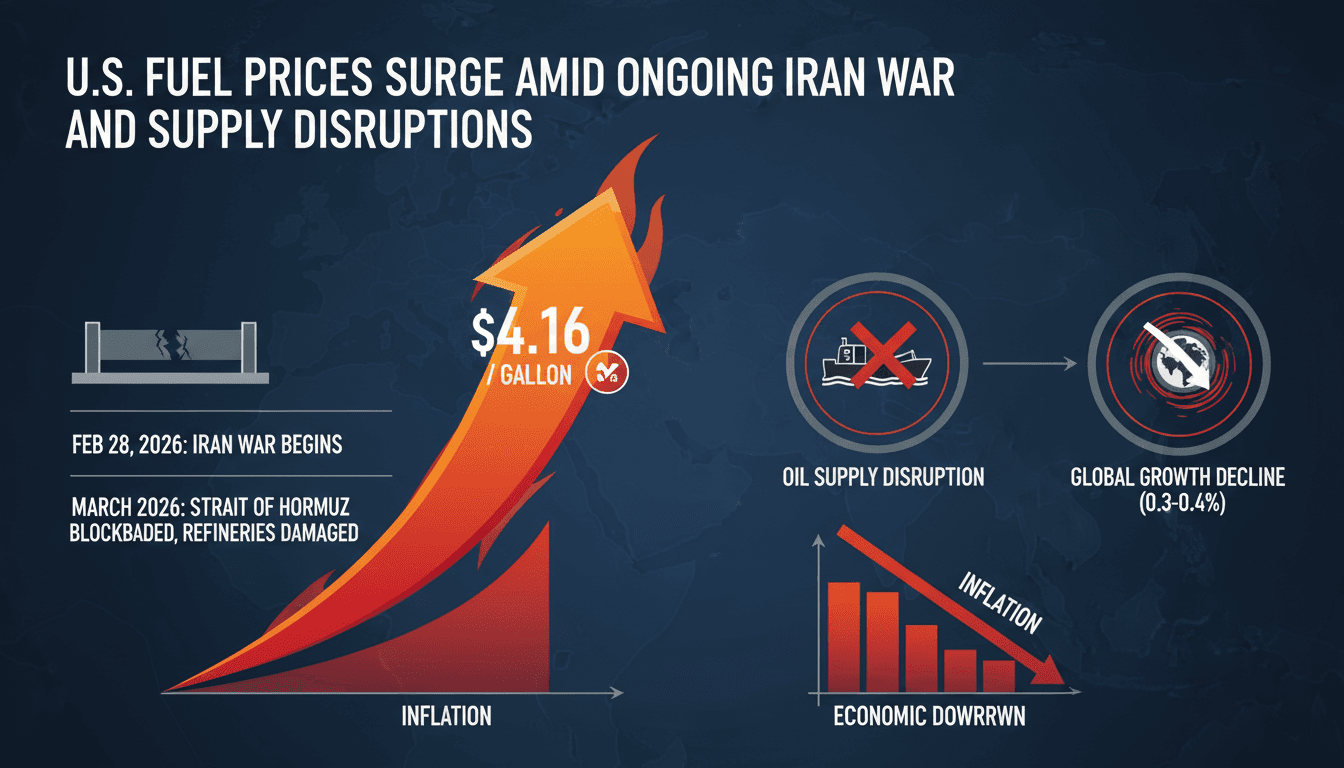
- April 10, 2026: Gasoline prices soar to $4.16 per gallon, with diesel hitting $5.67, as drivers cut back on travel.
- April 12, 2026: A fragile ceasefire is announced, with U.S.-Iran talks scheduled in Pakistan.
The context you actually need
- Supply Chain Disruption: The Strait of Hormuz blockade and damage to Middle Eastern refining capacity have severely impacted global oil supplies.
- Historical Tensions: The conflict stems from escalating U.S.-Iran tensions post-2024 elections, compounded by previous geopolitical events like Russia's invasion of Ukraine.
- Economic Impact: Increased fuel spending reached $10.4 billion from March 1 to April 10, 2026, leading to a 9% drop in gasoline demand.
What's really happening
The 2026 Iran War has disrupted oil supplies in a way that reverberates through the U.S. economy. The conflict began with U.S. and Israeli strikes on Iranian targets, which prompted Iran to retaliate by blocking the Strait of Hormuz, a critical chokepoint for global oil transport. This blockade, combined with damage to refining facilities, has resulted in a staggering 50% increase in global oil prices. As a direct consequence, U.S. gasoline prices surged to $4.16 per gallon, marking the sharpest rise in consumer fuel costs in nearly four years.
The economic implications are profound. Increased fuel spending of $10.4 billion from March 1 to April 10 has forced drivers from cities like Boston to Denver to alter their travel behaviors. Many are seeking cheaper gas stations, reducing trips, and even relying more on public transport or carpooling. The demand for gasoline has dropped by 9%, with consumption falling to 8.6 million barrels per day as of early April. This shift reflects not only the immediate financial strain on consumers but also a broader trend of economic adjustment in response to rising fuel costs.
In the backdrop, President Trump’s administration faces mounting pressure as public approval ratings decline ahead of the November 2026 midterms. The World Bank has warned of a potential 0.3-0.4 percentage point reduction in global growth and a 200-300 basis points increase in inflation due to the war's economic fallout. The fragile ceasefire, currently holding, is a temporary reprieve, with U.S.-Iran delegations scheduled to meet in Pakistan for permanent ceasefire talks. However, the geopolitical risk premium in oil markets remains, indicating that volatility may persist.
Who feels it first (and how)
- U.S. Drivers: Increased fuel costs lead to reduced travel and higher expenses.
- Truckers: Doubling diesel expenses impacts logistics and transportation costs.
- Low-Income Households: Higher fuel prices disproportionately affect those with limited budgets.
- Businesses: Increased operational costs due to fuel price hikes may lead to higher consumer prices.
What to watch next
- Ceasefire Negotiations: The outcome of talks in Pakistan on April 12 could determine the stability of oil prices. A successful agreement may ease supply disruptions.
- Fuel Demand Trends: Monitor gasoline consumption patterns in the U.S. Continued declines could signal a longer-term shift in consumer behavior.
- Global Economic Indicators: Watch for updates from the World Bank regarding growth forecasts. Changes could reflect the broader economic impact of the conflict.
Gasoline prices have surged to $4.16 per gallon due to the Iran War.
Continued geopolitical tensions will maintain volatility in oil markets.
The long-term economic impact on global growth remains uncertain.
Insights by A47 Intelligence
Regional and international reporting focused on Middle Eastern politics, diplomacy, and economics.
"Asharq Al-Awsat is a Saudi-owned international newspaper reflecting mainstream Gulf political perspectives."
— A47 Editor
From Boston to Denver, US Drivers Cut Back as Iran War Pushes Fuel Costs Higher
In response to rising fuel costs driven by the ongoing conflict involving Iran, drivers across the United States, from Boston to Denver, are significantly reducing their fuel consumption. The war has led to a notable increase in gasoline prices, whic...
Oil, metals, and agriculture: supply/demand headlines, OPEC chatter, inventories, and price action.
"Solid tape for energy and metals traders tracking macro and micro catalysts."
— A47 Editor
From Boston to Denver, US drivers cut back as Iran war pushes fuel costs higher
In response to rising fuel costs driven by the ongoing conflict in Iran, drivers across the United States, from Boston to Denver, are reducing their fuel consumption. The war has led to significant increases in gasoline prices, which have exceeded $4...