
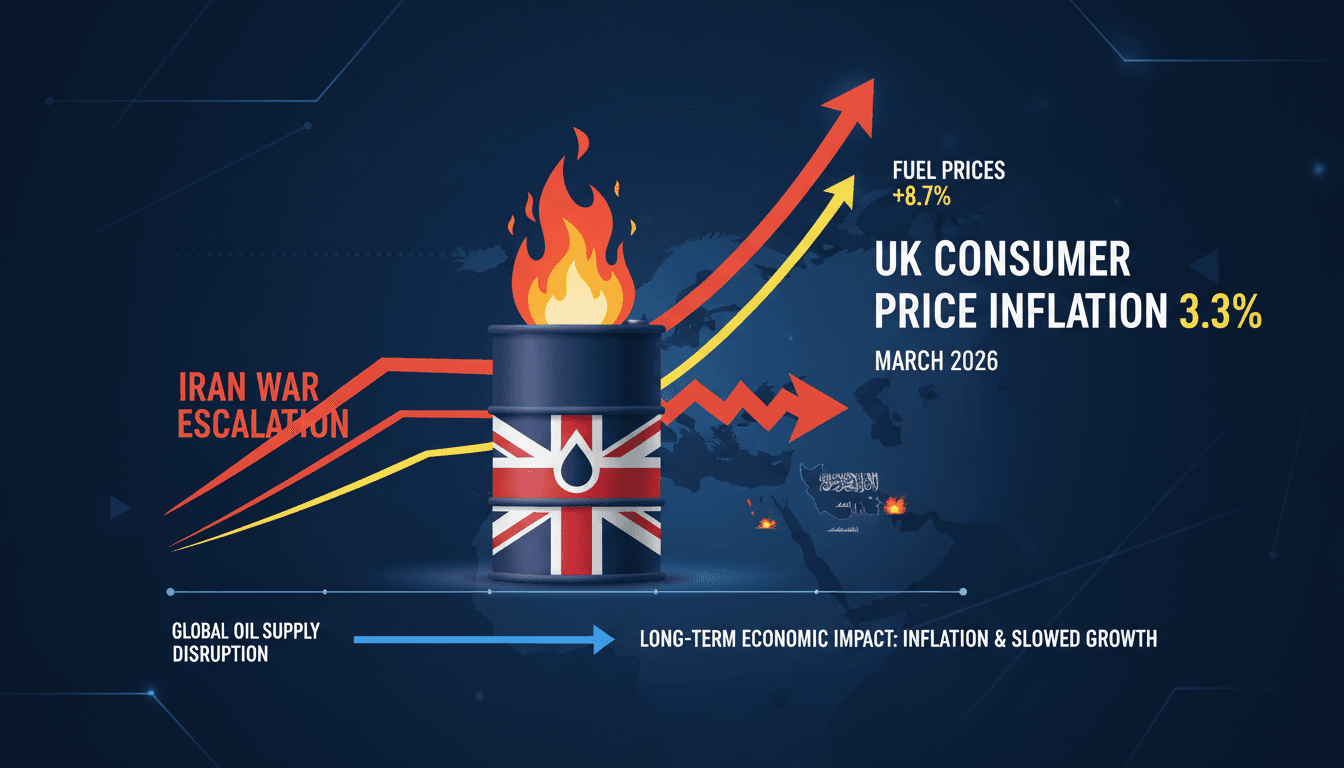
UK Consumer Price Inflation Hits 3.3% Amid Iran War Fuel Price Surge
Here's what it means for you.
If you drive or rely on transportation, expect higher costs as fuel prices continue to rise.
Why it matters
This inflation spike signals broader economic pressures that could affect consumer spending and growth.
What happened (in 30 seconds)
- UK annual consumer price inflation accelerated to 3.3% in March 2026, up from 3.0% in February.
- Motor fuel prices surged by 8.7% month-on-month, the largest increase since June 2022, driven by the Iran war.
- The Office for National Statistics released these figures on April 22, 2026, marking the initial economic impact of the conflict.
The context you actually need
- The Iran war began on February 28, 2026, with US and Israeli airstrikes, disrupting Middle Eastern energy supplies.
- Brent crude oil prices approached $100 per barrel by early March, leading to global fuel price increases.
- UK petrol and diesel costs reached 140.2 pence and 158.7 pence per litre, respectively, reflecting the war's impact on local markets.
What's really happening
The recent spike in UK consumer price inflation to 3.3% is primarily a consequence of geopolitical tensions stemming from the Iran war, which began on February 28, 2026. The conflict, initiated by coordinated airstrikes from the United States and Israel, has led to significant disruptions in the Middle East's energy supply chain. As Iranian forces retaliated with missile and drone attacks, the production and transportation of oil were severely impacted, particularly around the critical Strait of Hormuz. This escalation has caused Brent crude oil prices to surge toward $100 per barrel, which in turn has driven up fuel prices globally.
In the UK, the Office for National Statistics reported an 8.7% increase in motor fuel prices in March 2026 alone, marking the largest monthly rise since June 2022. This surge has been felt across the transport sector, where inflation climbed to 4.7%. The immediate effect of these rising costs is a direct hit to consumers, who are now paying significantly more for petrol and diesel, with prices reaching 140.2 pence and 158.7 pence per litre, respectively.
The Bank of England has responded by maintaining benchmark interest rates at 3.75%, while also revising inflation projections upward. They anticipate a peak inflation rate of 3.5% to 4% in mid-2026, contingent on the ongoing conflict's duration and intensity. Chancellor Rachel Reeves has emphasized the government's commitment to shielding consumers from excessive price hikes and enhancing energy security. However, opposition figures have criticized current fiscal strategies, arguing that they exacerbate vulnerabilities in the face of rising costs.
Economists from institutions like PwC and the IMF are warning of potential further increases in food and service inflation, alongside a possible slowdown in economic growth. The interconnectedness of global markets means that the repercussions of the Iran war will likely extend beyond fuel prices, affecting various sectors and consumer behavior in the UK and beyond.
Who feels it first (and how)
- Drivers and commuters: Higher fuel prices directly impact daily transportation costs.
- Transport sector: Increased operational costs may lead to higher prices for goods and services.
- Low to middle-income households: These groups are more sensitive to rising living costs, particularly in essential areas like fuel and food.
- Businesses reliant on logistics: Companies may face increased shipping costs, affecting pricing strategies and profit margins.
What to watch next
- Fuel price trends: Monitor ongoing fluctuations in global oil prices, as they will directly influence UK consumer costs.
- Bank of England policy changes: Any adjustments to interest rates or inflation forecasts will signal the central bank's response to economic pressures.
- Consumer spending patterns: Watch for shifts in consumer behavior as rising costs may lead to reduced discretionary spending.
Inflation has risen to 3.3% due to increased fuel prices.
Further inflation increases are expected, potentially peaking at 3.5% to 4%.
The long-term economic impact of the Iran war on UK inflation and consumer behavior remains uncertain.
Insights by A47 Intelligence
Corporate finance news, M&A, deals, and executive interviews.
"Finance Monthly serves a professional readership with corporate finance coverage."
— A47 Editor
UK Inflation Is Back Above 3%. The Harder Problem Is Growth
UK inflation has risen to 3.3% in March 2026, up from 3.0% in February, as reported by the Office for National Statistics. This increase is primarily attributed to soaring fuel prices linked to the ongoing conflict in Iran, which has significantly im...
Key macro releases (CPI, jobs, PMIs), surprise indexes, and market implications.
"Great for data-print awareness and instant read-through to rates and risk assets."
— A47 Editor
UK inflation jumps to 3.3% as fuel prices surge; BoE rate hike seen unlikely
UK inflation has surged to 3.3% in March 2026, a significant increase attributed to the largest rise in fuel prices in over three years, driven by the ongoing conflict in Iran. This inflation spike marks a notable rise from 3.0% in February, reflecti...
UK and international business news, economics, and corporate coverage.
"The Guardian’s business section covers finance and markets with a progressive editorial tone."
— A47 Editor
UK inflation rises to 3.3% amid biggest jump in fuel prices in more than three years
UK inflation has risen to 3.3% in March 2026, marking a significant increase attributed to the ongoing conflict in Iran, which has caused the largest jump in fuel prices in over three years. This rise reflects the initial economic impact of the war o...
Political developments, policy debates, elections, and government affairs in the UK.
"BBC News is widely regarded as a reputable international news organization, known for its impartial tone and public service mandate."
— A47 Editor
UK inflation rises after Iran war pushes up fuel prices
UK inflation has risen to 3.3% in March 2026, marking a significant increase attributed to the ongoing conflict in Iran, which has caused the largest jump in fuel prices in over three years. This rise reflects the initial economic impact of the war o...
Global markets, investing, and macroeconomics from a premier financial newsroom.
"Bloomberg is respected for in-depth financial reporting and data-driven analysis."
— A47 Editor
UK Inflation Accelerates on Higher Petrol Costs
UK inflation accelerated to 3.3% in March, up from 3% the previous month, primarily driven by rising energy costs linked to the ongoing conflict in Iran. This surge in inflation reflects the increasing financial burden on consumers as energy prices r...
Corporate news, economic trends, and markets with UK and global scope.
"BBC News is widely regarded as reputable and impartial, with a public service mandate."
— A47 Editor
UK inflation rises after Iran war pushes up fuel prices
The UK inflation rate has risen to 3.3% in March, reflecting the initial economic impact of the ongoing conflict in Iran, which has significantly increased fuel prices. This rise in inflation marks a concerning trend for the cost of living in the UK ...
UK and international business news, economics, and corporate coverage.
"The Guardian’s business section covers finance and markets with a progressive editorial tone."
— A47 Editor
UK inflation climbs to 3.3%, driven by largest increase in fuel prices in over three years – business live
The UK inflation rate has risen to 3.3% in March, primarily driven by the largest increase in fuel prices in over three years, reflecting the economic impact of the ongoing conflict in Iran. Core inflation, excluding volatile items, has slowed slight...
UAE-based English-language newspaper covering regional politics, economics, and global affairs.
"The National reflects Emirati policy perspectives while maintaining international editorial standards."
— A47 Editor
UK inflation leaps in March as Iran war takes toll
UK inflation surged in March 2026, primarily driven by rising energy prices linked to the ongoing war in Iran, which has exacerbated economic pressures in the region. This inflationary spike reflects the broader impact of geopolitical tensions on dom...
Regional and international reporting focused on Middle Eastern politics, diplomacy, and economics.
"Asharq Al-Awsat is a Saudi-owned international newspaper reflecting mainstream Gulf political perspectives."
— A47 Editor
UK Inflation Jumps in March as Middle East War Propels Energy Prices
UK inflation surged in March 2026, primarily driven by escalating energy prices linked to the ongoing conflict in the Middle East, particularly the war in Iran. This increase reflects the economic pressures stemming from geopolitical tensions that ha...
Social/economic commentary and analysis relevant to business and markets.
"WSJ blends data-driven economic insight with commentary on policy and society."
— A47 Editor
U.K. Inflation Jumps as Iran War Pushes Fuel Prices Higher
The U.K. inflation rate has surged to 3.3% in March, primarily driven by rising fuel prices linked to the ongoing conflict in Iran. This increase in inflation reflects the economic repercussions of the war, which has significantly impacted energy cos...
Pan-Arab news coverage spanning politics, business, sports, and regional affairs.
"Asharq Al-Awsat reflects a broad Arab editorial perspective with strong attention to regional geopolitics."
— A47 Editor
التضخم السنوي في بريطانيا يقفز إلى 3.3 % مع بدء ظهور آثار الحرب
The annual inflation rate for consumer prices in Britain has risen to 3.3% in March, up from 3.0% in February, indicating a significant increase in the cost of living. This rise is attributed to the emerging effects of ongoing conflicts, which are im...
Macro commentary, policy analysis, growth/inflation themes, and global outlooks.
"Contextual macro coverage that complements day-to-day market headlines."
— A47 Editor
UK inflation rises to 3.3% as Iran war impact begins to hit
The UK inflation rate has risen to 3.3% in March, driven by the economic repercussions of the ongoing conflict in Iran, which has led to increased fuel prices. This rise marks a significant concern for consumers as the cost of living continues to esc...
International coverage from The Guardian's global desks.
"The Guardian is known for its progressive editorial stance and in-depth analysis."
— A47 Editor
UK inflation rises to 3.3% amid soaring fuel prices driven by Iran war
UK inflation rose to 3.3% in March, driven by a significant increase in fuel prices linked to the ongoing conflict in Iran, marking the largest jump in over three years. This rise follows a previous rate of 3% in February, as reported by the Office f...
Practical investing ideas, macro commentary, and market strategy.
"MoneyWeek is a UK-based investment magazine focused on actionable insights."
— A47 Editor
UK inflation rate rises to 3.3% as Iran war pushes prices higher
The UK inflation rate has risen to 3.3% in March, driven by the economic repercussions of the ongoing conflict in Iran, which has led to increased fuel prices. This rise marks a significant concern for consumers as the cost of living continues to esc...