
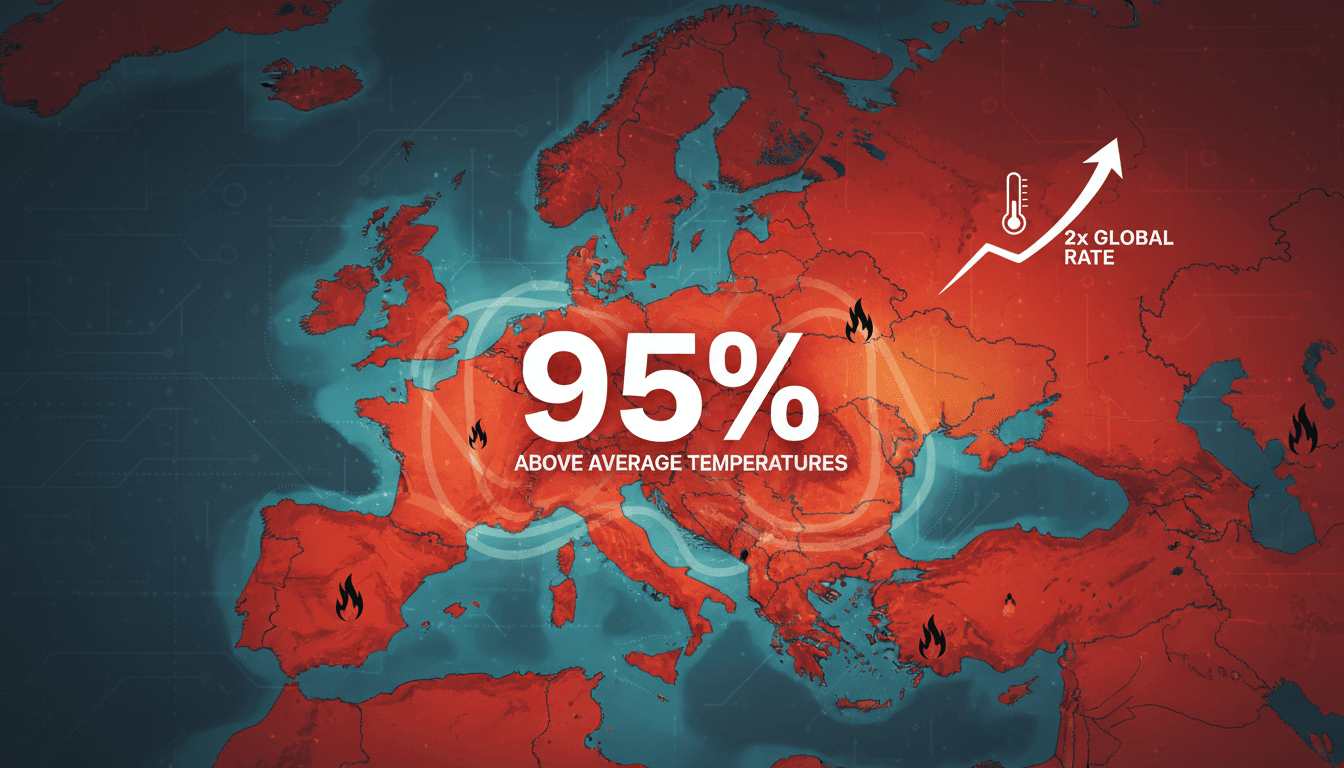
Europe Experiences Record Heat in 2025 with 95% of Continent Above Average Temperatures
Here's what it means for you.
As climate extremes escalate in Europe, global travel patterns and energy markets may shift, impacting your plans and costs.
Why it matters
The unprecedented rise in temperatures across Europe signals a critical juncture in climate change, affecting global weather patterns and economic stability.
What happened (in 30 seconds)
- 95% of Europe recorded above-average temperatures in 2025, marking it the third-warmest year on record.
- Record wildfires burned over 1 million hectares, while marine heatwaves affected 86% of regional waters.
- Heatwaves prompted a 14% spike in power demand, leading to temporary price surges and reduced GDP growth forecasts.
The context you actually need
- Europe's warming rate has exceeded twice the global average since the 1980s, with a 0.56°C increase per decade over the last 30 years.
- Previous years (2023 and 2024) saw escalating climate extremes, including record heat and floods, setting the stage for 2025's anomalies.
- Greenhouse gas emissions fell by 2.5% in 2025, but the impact of heatwaves on energy demand and economic forecasts indicates a complex relationship between climate action and immediate consequences.
What's really happening
In 2025, Europe experienced a dramatic temperature anomaly, with nearly all of its landmass recording above-average annual temperatures. This was not an isolated incident but rather the culmination of long-term climatic trends exacerbated by greenhouse gas accumulation and shifting atmospheric patterns. The Copernicus Climate Change Service reported that the continent's average temperature reached 10.41°C, which is 1.17°C above the 1991-2020 average.
The extreme weather events of 2025, including record wildfires and marine heatwaves, were driven by a combination of factors. The persistent high-pressure systems over northern and central Europe, coupled with low-pressure systems in the south, created conditions ripe for heatwaves. The summer of 2025 was particularly severe, with a 21-day heatwave in sub-Arctic Fennoscandia, where temperatures soared to 30°C near the Arctic Circle, marking the longest such event on record.
The implications of these climatic shifts extend beyond immediate weather patterns. The rise in sea surface temperatures and the prevalence of marine heatwaves have significant repercussions for marine ecosystems, fisheries, and coastal economies. The wildfires, which consumed over 1 million hectares, not only devastated local environments but also contributed to increased carbon emissions, further exacerbating the climate crisis.
As Europe grapples with these extremes, the economic fallout is becoming evident. The heatwaves led to a 14% increase in electricity demand, which temporarily doubled energy prices. This spike in demand, coupled with the ongoing transition to renewable energy sources—46.4% of electricity came from renewables in 2025—highlights the delicate balance between energy supply and climate resilience. The EU's commitment to reducing greenhouse gas emissions by 39% below 1990 levels by 2030 is now more critical than ever, as the region faces the dual challenge of mitigating climate change while adapting to its immediate impacts.
Who feels it first (and how)
- Travelers: Increased heat in Europe may lead to a decline in tourism as travelers seek cooler destinations.
- Energy consumers: Higher energy prices during heatwaves will affect household budgets and business costs.
- Agricultural sectors: Farmers may face crop failures due to extreme weather, impacting food supply chains and prices.
- Coastal communities: Rising sea temperatures and marine heatwaves threaten fisheries and coastal economies.
What to watch next
- Energy market fluctuations: Monitor how energy prices respond to ongoing climate extremes and demand spikes.
- Travel trends: Watch for shifts in travel patterns as tourists adjust their destinations based on climate conditions.
- Policy responses: Keep an eye on EU and national policies aimed at climate resilience and renewable energy investments.
95% of Europe experienced above-average temperatures in 2025.
Continued climate extremes will affect energy markets and travel patterns globally.
The long-term economic impacts of these climate anomalies on various sectors remain to be fully assessed.
This article was generated by AI from 6 verified sources and reviewed by A47 editorial systems.
24/7 international news from a French perspective in multiple languages.
"France 24 is viewed as a globally focused outlet with balanced coverage and a European perspective."
— A47 Editor
Nearly all of Europe had above-average heat last year, as climate records toppled
In 2025, nearly all of Europe experienced above-average heat, setting records for wildfires, sea temperatures, and heatwaves, as reported by EU scientists and the World Meteorological Organization. This alarming trend highlights the worsening impacts...
Discoveries, research, environment, and health innovations.
"New Scientist is a well-respected publication offering accessible science news, commentary, and expert analysis."
— A47 Editor
Extreme weather in 2025 drove record wildfire emissions in Europe
In 2025, Europe experienced extreme weather conditions, including unprecedented wildfires and heatwaves, with temperatures reaching 30°C within the Arctic Circle during a three-week hot spell. This led to record wildfire emissions across the continen...
Pan-Arab news coverage spanning politics, business, sports, and regional affairs.
"Asharq Al-Awsat reflects a broad Arab editorial perspective with strong attention to regional geopolitics."
— A47 Editor
تسجيل درجات حرارة أعلى من المتوسط في معظم أوروبا خلال 2025
Scientists from the European Union and the World Meteorological Organization reported that most of Europe experienced above-average temperatures in 2025. This trend indicates a significant shift in climate patterns across the continent, raising conce...
Global news coverage with extensive reporting on Middle Eastern conflicts and geopolitics.
"Al Jazeera is a Qatar-based broadcaster known for wide regional coverage and alternative perspectives."
— A47 Editor
Europe named ‘fastest-warming continent’ in latest climate change report
A recent report by the UN has identified Europe as the fastest-warming continent, highlighting severe impacts such as heatwaves, wildfires, and diminishing ice cover. This alarming trend underscores the urgent need for climate action as the continent...
Comprehensive coverage of Middle Eastern and global issues.
"Al Jazeera is a prominent voice from the Global South, especially the Middle East, with an emphasis on underreported stories."
— A47 Editor
Europe named ‘fastest-warming continent’ in latest climate change report
A recent report by the UN has identified Europe as the fastest-warming continent, highlighting severe impacts such as heatwaves, wildfires, and diminishing ice cover. This alarming trend underscores the urgent need for climate action as the continent...
News and current affairs from across Europe.
"The Guardian is known for its progressive editorial stance and in-depth analysis."
— A47 Editor
Nordic heatwave part of record year that saw temperatures scorch most of Europe, report finds
A recent report indicates that the Nordic heatwave, which saw temperatures exceed 30C (86F) in the Arctic Circle during July, is part of a record year where over 95% of Europe experienced abnormal heat. This extreme weather resulted in 21 days of int...
International news, politics, and culture.
"Sky News is a UK-based 24-hour channel known for fast-breaking news and political coverage."
— A47 Editor
Solar power soars to new heights but fears over 'dangerously high' temperatures
A recent climate study revealed that nearly all of Europe experienced above-average temperatures in 2025, leading to record wildfires and heatwaves, particularly in regions like Veiga das Meas, Spain. The alarming rise in temperatures has raised conc...
Tech industry news, innovation, gadgets, and startups from a UK broadcaster.
"Sky News is often seen as a center-right outlet in the UK, known for its rolling coverage and breaking stories."
— A47 Editor
Solar power soars to new heights but fears over 'dangerously high' temperatures
A recent climate study revealed that nearly all of Europe experienced above-average temperatures in 2025, leading to record wildfires and heatwaves, particularly in regions like Veiga das Meas, Spain. The alarming rise in temperatures has raised conc...